
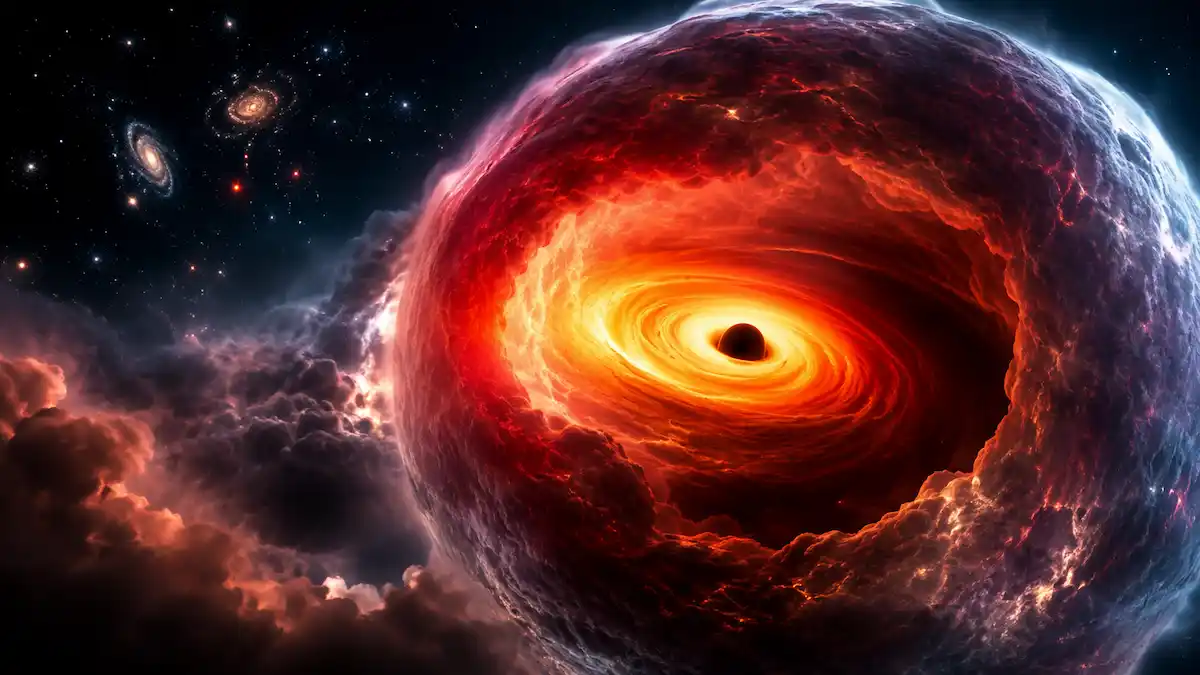
The black hole star discovery has given astronomers a remarkable glimpse of a cosmic object that may hide a massive black hole inside an enormous envelope of hydrogen. A mysterious red object found by the James Webb Space Telescope (JWST) has challenged astronomers’ understanding of what a young black hole star can look like. This unusual object, named MoM-BH*-1, seems to be an extremely compact and unusually red source from the time when the universe was only about 660 million years old. MoM-BH*-1 is one of the most surprising black hole star discovery because astronomers have suggested that it may well be a new class of extraordinarily massive hydrogen gas-enveloped astrophysical objects.
Scientists found suspicious compounds in New Jersey meteorite
The reason why the black hole star discovery was surprising is that this object did not behave like a common star or an active galaxy. Its spectrum showed uncommon spectral features that could hardly be explained by standard stellar populations, while its energy output exceeded by far the power from typical nuclear fusion. As a result, we were surprised to see an object that looked like a star but, in reality, it may hide a giant black hole at its core.
The Strange Red Object JWST Found in the Early Universe
The story began when astronomers were looking at the results of the JWST Ultra Deep Survey as part of the Mirage or Miracle (MoM) program. MoM-BH*-1 drew their attention due to its unusual color, brightness, and size. It was detected in the far-infrared range but was not observed in shorter infrared wavelengths. Astronomers then used JWST’s Near-Infrared Spectrograph (NIRSpec) to examine its light in much greater detail. The observations confirmed a spectroscopic Redshift of about 7.76, placing the source roughly 660 million years after the Big Bang. That means scientists are seeing the object as it existed during cosmic dawn, when the earliest galaxies and black holes were still developing.
This timing makes the black hole star discovery even more remarkable. Astronomers have long known that incredibly massive black holes existed in the universe at a very early time, but there has yet to be any satisfying explanation for how they came to be so large so quickly, which is one of the great mysteries in modern astrophysics today. The first big hint in to what was going on came from analyzing the spectrum of the star-like object. Instead of seeing a smoothly varying hump like what we expect from normal stars, they found an enormous Balmer break due to hydrogen gas. It’s much larger than we would expect to see from normal stellar populations.
Why Scientists Think a Black Hole Is Hidden Inside?
Normal stars glow due to the energy released in the process of converting lighter elements to heavier ones at their cores through nuclear fusion. Even the most massive stars have limitations as to how much energy can be produced by fusion reactions.
But MoM-BH*-1 seems to vastly exceed these values, being out-of-this-world. The MIT scientists explain that this object radiates energy 100 billion times bigger than anything ordinary stars are capable of producing. However, it does not mean that it contains 100 billion regular stars inside of it. On the contrary, this statement points towards much more powerful energy source. A black hole at the center of MoM-BH*-1, actively consuming other matter.
When gas falls on a black hole, it is capable of transferring its kinetic energy to photons through heating processes, thus, becoming a source of energy itself. In the case of MoM-BH*-1, it seems that the energy from the black hole is not emitted directly into the surrounding space. In effect, the astronomers at the MIT state that a huge amount of dense hydrogen gas surrounding the black hole in MoM-BH*-1 can become comparable to a surface of an ordinary star, forming an imitation of a photosphere of a regular star. Thus, they call it a pseudo-photosphere. This is the main explanation of why such a black hole star exists. The pseudo-photosphere allows the gas to reflect the photon emissions produced by the black hole, which makes the whole system look like that of a single massive star.
YOU MAY LIKE
- New Tesla Roadster Takes Flight — But Elon Musk’s Original Car Is Still in Space
 This week, Tesla Roadster comes twice in the news for two very different reasons. On October 15, 2026, Tesla showed off a new Roadster prototype in Texas that appeared to lift off the ground using thruster technology inspired by SpaceX. While the new Roadster was making headlines on Earth, the original red Tesla Roadster that… Read more: New Tesla Roadster Takes Flight — But Elon Musk’s Original Car Is Still in Space
 - Astronomers Find the First Green Star – Could Our Sun Also Glows Green After it Dies?
 Astronomers just found the first green star and the reason of its unusual color is surprising. Astronomers at the University of Warwick have detected a dead star that actually looks green to the human eye, something that never confirmed before research. Scientists believe that the star has gained this green color because it consumes some… Read more: Astronomers Find the First Green Star – Could Our Sun Also Glows Green After it Dies?
 - Microblazar Discovered In Our Galaxy, After 30 Years of Searching And Its Jet Is Pointed Straight At Earth
 Recently a microblazar has been confirmed in our own galaxy, Milky Way. Scientists have been investing this cosmic mystery for nearly 30 years. The study reveals that the object named IRAS 18293-0941 sits about 1200 light years away from Earth and one of its powerful jets points straight towards the Earth. It sounds danger but… Read more: Microblazar Discovered In Our Galaxy, After 30 Years of Searching And Its Jet Is Pointed Straight At Earth
 - Orionid Meteor Shower: The Ancient Shooting Stars That Left By Halley’s Comet Centuries Before You Were Born
 The Orionid Meteor Shower returns this month, and brings beautiful streaks of lights and fill the dark sky with colours. Each meteor burning up in the sky is a tiny piece of dust that left behind by the Halley’s Comet hundreds of years ago. Now centuries past, and when Earth passes through this old trail… Read more: Orionid Meteor Shower: The Ancient Shooting Stars That Left By Halley’s Comet Centuries Before You Were Born
 - Northern Lights Alert: Aurora May Be Visible in 22 US States Tonight
 Northern Lights Alert is going out across parts of the United States tonight, and if you live in the right state, you might get a rare chance to see the aurora borealis without booking a flight to Alaska or Iceland. NOAA’s Space Weather Prediction Center has issued a geomagnetic storm watch for the night of… Read more: Northern Lights Alert: Aurora May Be Visible in 22 US States Tonight
The Spectral Clue That Changed the Picture

The strongest evidence was not in the appearance of the object. It was in the spectroscopy, which identified widespread emission of H-beta and H-gamma. This combination is very difficult to produce by normal stars. The Nature article found a Balmer-break value around 7.7 which is considerably higher than the maximum value predicted for normal dust-free stellar populations. The scientists also found that the hydrogen absorption requires an extremely high density of gas, with densities of hydrogen being more than 109 particles per cm3.
The black hole star discovery became more likely to be true when researchers started to test different models of physical processes that could explain away the odd observations in favor of the existence of a black hole. The researchers used spectral-synthesis calculations to determine if an accreting black hole with dense and turbulent gas could explain the observations. They found that to match up the observations, they needed incredibly dense gas (1011 hydrogen atoms per cubic centimeter) along with turbulence in order to explain these observations.
Another important finding was that, dust does not appear to play the dominant role in causing the peculiar red color of the object. The Nature paper points out that the unusual color and spectral break can be explained by the dense gas surrounding the black hole instead of the thick dust that is often found in some galaxies. This finding makes the black hole star discovery more interesting than a simple observation of a distant dusty galaxy.
Could It Explain JWST’s Mysterious Little Red Dots?
JWST has discovered thousands of little red dots in the early universe. These are astronomical objects with unusual red colors. Scientists are having a hard time figuring out what they are because their spectra have characteristics of stars, dense gas clouds, and black holes.
MoM-BH*-1 could be an answer. The researchers have calculated, if an object like MoM-BH*-1 ended up in the core of a young galaxy, it would affect the galaxy’s spectrum. Their calculations showed that it could create a spectrum similar to the spectrum of the little red dots found by JWST. This does not mean that every little red dot is a black hole star. However, it does give astronomers something to work with and test against future observations. The black hole star discovery is connected to the bigger mystery of the little red dots because it helps to explain what those little red dots are.
Why the Black Hole Star Discovery Could Change Our View of Cosmic Dawn?
The most interesting aspect of the black hole star discovery is not that JWST telescope has found another distant red point. It is rather astronomers’ realization that they may have observed a stage of black-hole growth that had previously existed mainly in theoretical models.
MoM-BH*-1 seems to combine two well-known theories about the cosmos into one amazing discovery. These are the theory of enormous energy produced by an accreting black hole and the star-like appearance but different density of a star’s hydrogen envelope. Even though from the Earth, astronomers see only a tiny red spot, there may be a black hole with gas around it as big as our solar system at the center of that red dot. It emitted its light several billion years ago when the universe was very young.
However, researchers are not so confident about this black hole star discovery. It should rather be called a black hole star candidate because scientists were able to analyze it with a JWST’s spectroscopy technique. It means that astronomers observe the spectrum of light emitted by the object rather than directly see the black hole at the center of MoM-BH*-1. If further observations confirm this black hole star discovery, it may help scientists reveal how universe’s first black holes acquired their tremendous mass. They also would explain why early universe was so full of puzzling little red dots.