
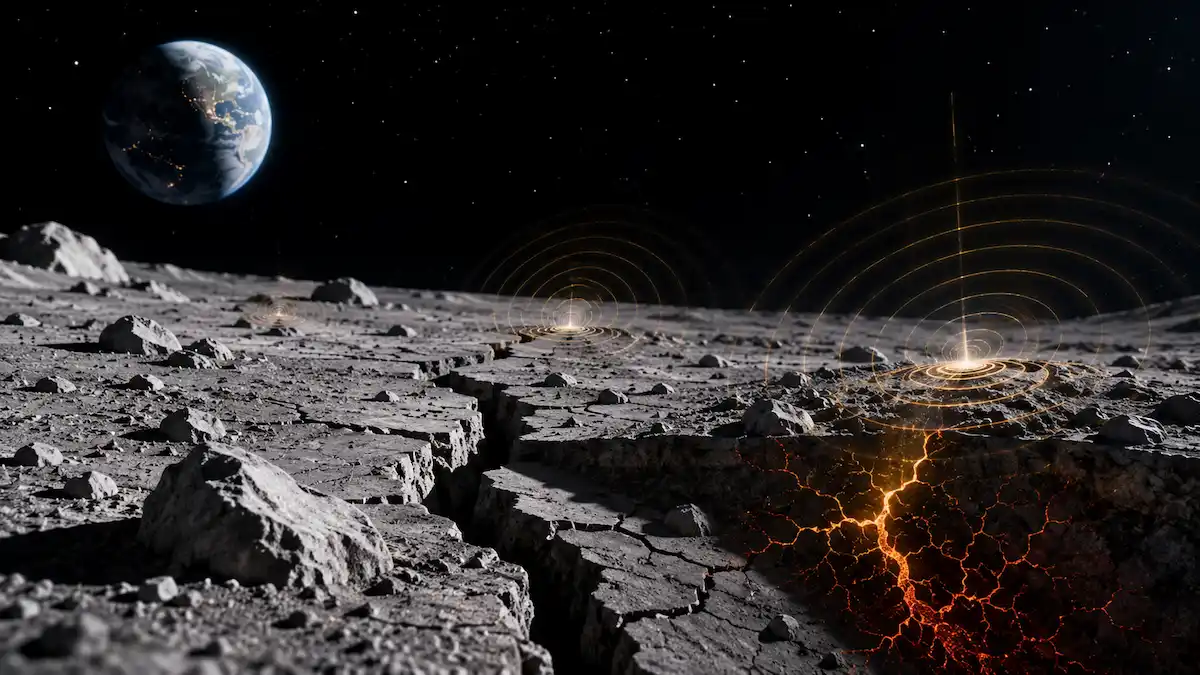
What causes moonquakes on a desolate world where tectonic plates do not move around like they do on Earth? The answer is far from simple because the moon’s core is still cooling, the moon’s crust is contracting, the Earth is tugging at the moon, and meteorites are hitting the moon.
The Apollo astronauts found out that there was a deeper source of rumbling in the moon’s crust. They placed a number of seismometers on the lunar surface. The seismometers detected a number of different types of moon tremors. The moon can have a huge variety of moonquakes for different reason, from a deep down disturbance caused by the gravity pulling from the Earth, to temperature changes on the moon’s surface. The most fascinating thing about moonquakes is that the deeper quakes are far more abundant than the shallow ones. What causes moonquakes depends on which type of moonquake we are talking about. Some occur many miles beneath the surface while others are just on the surface itself.
Why Moon South Pole decide the future of moon bases?
How the Moon’s Cooling Causes Moonquakes?
One of the most interesting answers to the question of what causes moonquakes is connected with the history of moon’s temperature.
About 4.5 billion years ago our natural satellite (moon) was formed, and it was considerably hot, but since then it has been cooling down. As a result, the moon’s core is gradually reducing in size. But since the moon is too cold to have any significant geological activity scientists believed that this process was going on very slowly. However, over the period of hundreds of millions of years such slow changes can add up. According to NASA lunar geologists the moon’s diameter has decreased by approximately 50 to 100 meters (150 to 330 feet) over these periods of time. And some studies estimate a maximum reduction of 200 meters over the last one billion years.
As the moon contracts it creates stresses in its’ crust that eventually can cause breaks and displacements of the rocks. Thrust faults are formed as a result of such pressure when one section of the moon’s surface is pushed over another section. As a result of these changes, there is a sudden release of energy in the form of seismic waves. These are the moonquakes. According to NASA Lunar Reconnaissance Orbiter has found thousands of young faults on the moon’s surface, which are most likely the result of the moon’s contraction.
YOU MAY LIKE
- Milky Way’s Black Hole Is Slowly Destroying Itself to Power Cosmic Rays”
 Milky Way’s black hole may be doing something scientists never expected. It is sacrificing a piece of itself to power some of the most energetic particles in our galaxy. A theoretical study suggests that Sagittarius A*, the supermassive black hole present at the center of the Milky Way, could be using its own spinning energy… Read more: Milky Way’s Black Hole Is Slowly Destroying Itself to Power Cosmic Rays”
 - New Tesla Roadster Takes Flight — But Elon Musk’s Original Car Is Still in Space
 This week, Tesla Roadster comes twice in the news for two very different reasons. On October 15, 2026, Tesla showed off a new Roadster prototype in Texas that appeared to lift off the ground using thruster technology inspired by SpaceX. While the new Roadster was making headlines on Earth, the original red Tesla Roadster that… Read more: New Tesla Roadster Takes Flight — But Elon Musk’s Original Car Is Still in Space
 - Astronomers Find the First Green Star – Could Our Sun Also Glows Green After it Dies?
 Astronomers just found the first green star and the reason of its unusual color is surprising. Astronomers at the University of Warwick have detected a dead star that actually looks green to the human eye, something that never confirmed before research. Scientists believe that the star has gained this green color because it consumes some… Read more: Astronomers Find the First Green Star – Could Our Sun Also Glows Green After it Dies?
 - Microblazar Discovered In Our Galaxy, After 30 Years of Searching And Its Jet Is Pointed Straight At Earth
 Recently a microblazar has been confirmed in our own galaxy, Milky Way. Scientists have been investing this cosmic mystery for nearly 30 years. The study reveals that the object named IRAS 18293-0941 sits about 1200 light years away from Earth and one of its powerful jets points straight towards the Earth. It sounds danger but… Read more: Microblazar Discovered In Our Galaxy, After 30 Years of Searching And Its Jet Is Pointed Straight At Earth
 - Orionid Meteor Shower: The Ancient Shooting Stars That Left By Halley’s Comet Centuries Before You Were Born
 The Orionid Meteor Shower returns this month, and brings beautiful streaks of lights and fill the dark sky with colours. Each meteor burning up in the sky is a tiny piece of dust that left behind by the Halley’s Comet hundreds of years ago. Now centuries past, and when Earth passes through this old trail… Read more: Orionid Meteor Shower: The Ancient Shooting Stars That Left By Halley’s Comet Centuries Before You Were Born
Earth Is Also Making the Moon Shake
Now, the second explanation of what causes moonquakes involves a much farther away actor: Earth itself.

Like the gravitational effect of the Moon on Earth’s oceans (causing tides), the Earth’s gravity also induces tidal stresses in the Moon’s interior. These stresses are generally not strong enough to cause significant deformation. But in specific regions deep inside the Moon, repeated tidal stresses can trigger seismic events. These are known as deep moonquakes.
Data from the Apollo missions revealed that such quakes occur hundreds of kilometers below the surface, way deeper than any of the shallow moonquakes described above. They are generally weaker than the strongest shallow moonquakes, but they are also much more common.
The fact is that many of these deep quakes occur in the same small area over and over again, being related to the lunar tidal stress. Historical Apollo missions data revealed that some of the repeated lunar quakes have a periodicity of about 27-28 days. So, the stress is not making the moon quake randomly, but following a certain pattern with a length of about one month. Therefore, it is not an unexpected impact that makes the moon tremble. Instead, the moon is squeezed from time to time. So the Earth itself is also a reason for what causes moonquakes.
The Moon Has Powerful Shallow Moonquakes Too
Deep moonquakes are definitely not the only explanation for what cause of moonquakes. The moon also has shallow moonquakes that originate much closer to the surface. These shallow quakes are especially interesting because they can be far stronger than the typical deep moonquake. According to NASA’s recent moonquakes page, these quakes, caused by the compressing of the moon and can be up to 25-30 kilometers below the surface and can reach up to 5.5 on the moment magnitude scale, and can last for more than ten minutes.
The cause of these quakes is the same as regular quakes: stress builds up in the brittle layer of the moon’s lithosphere. Think about it as if you were to squeeze a dry block of rock until it cracks or the existing cracks in the rock begin moving. The same way, even on a very large scale, is how the reducing in the size of the moon accounts for these specific shallow moonquakes. The effects of these quakes could be very impactful on the future of lunar exploration. NASA-funded studies have found that these quakes have been found to occur near some of the possible landing sites that are being considered for future lunar missions, including the moon’s South Pole.
Meteoroids Can Hit the Moon and Trigger Seismic Waves

Another simple answer that explains what causes moonquakes is something crashing into the Moon. Unlike the Earth, the Moon has a thin atmosphere, if you want to call it that, which means lots of small meteoroids, can crash into the Moon’s surface without slowing down. The moment when a meteoroid hits the moon, the kinetic energy from the impact will be converted into thermal energy and the kinetic energy will go into the ground, causing excavated material to fly off at some angles, forming a crater. Some of the energy from the impact goes into seismic waves, which Apollo’s seismographs picked up. Meteoroids are also a major reason for what causes moonquakes.
In fact, Apollo’s analysis of the seismic data showed that meteoroid strikes could have produced some of the largest recorded magnitude on the lunar seismographs. While this is a different type of moonquake, it’s still a moonquake because it has seismic waves that reach the ground, no matter what causes it, whether it’s a fault line on the Moon or the ground being hit by something else.
The Moon Can Shake Because of Extreme Temperature Changes
One of the strangest answers to what causes moonquakes involves sunlight. The temperature on the moon varies from day to night as the moon does not have an atmosphere to hold the heat in like the earth. Unlike the earth, the day and night on the moon last for approximately two weeks. The temperature drops at night and rises drastically during the day, causing the rocks on the surface to expand and contract.
The ground on the earth, however, is able to expand and contract to a small degree due to the slighter change in atmospheric temperature that lasts for only 24 hours. The atmosphere of the earth also helps reduce the stress on rocks by cushioning the drastic changes between day and night. On the moon, there is no atmosphere to help cushion the heat, and the longer day and night causes much more drastic changes in temperature.
The stress caused by these changes can cause small moonquakes, where the rocks begin to loosen and slide past each other. These are also known as thermal moonquakes or thermal seismic events. It was reported by the Apollo 17 that some seismic events happened frequently after sunrise occurred and the temperature started to rise. To the surprise of NASA, it was discovered that very shallow seismic events were happening most frequently. The moon was essentially able to shake itself! Sunlight causing moonquakes seems unlikely, but it’s a possibility with the variation of temperature caused by the lack of a stable day to night cycle on the moon. It is another reason for what causes moonquakes.
Why Moonquakes Are Different From Earthquakes?
Understanding what causes moonquakes becomes easier when we compare the Moon with Earth.
On earth, most strong earthquakes happen because of plate tectonics. This is where earth’s plates are constantly moving around. When the pressure builds up between plates, it causes an earthquake when the rocks on the fault lines break.
The moon has none of the plate tectonics that cause earthquakes on earth. The leading causes for seismic waves on the moon seem to be thermal expansion, tidal flexure, and impact vibrations. These are only some of the potential causes.
The other problem is that the moon’s geology is different from earths. The long periods of time that the rocks have been exposed to impact erosion, has made the moon’s crust fragmented, which results in some unusual seismic waves when it comes to moonquakes. These seismic waves that Apollo found while studying the moon, allowed scientists to determine the density of the moon’s crust, mantle, and core. this difference help us to know well about what causes moonquakes.
Conclusion
So, what causes moonquakes?
Well, there are several different reasons for this. Deep moonquakes are caused by seismic stress from Earth’s gravity on the moon, shallow quakes happen when the core of the moon shrinks and causes compression of the brittle outer crust, moonquakes from meteoroid impacts happen when meteors crash into the surface, and thermal moonquakes happen when rocks expand and contract from the huge temperature differences between night and day on the moon.
What’s surprising is that some of these causes are still happening right now. The moon’s been steadily cooling since it first formed, and as a result it’s been slowly shrinking over time; it’s estimated to have shrunk by 50 to 100 meters in the last few hundred million years. It may seem calm and dead to us observers back on earth, but there’s a whole world of gravity, heat, and rock mechanics going on underneath that dusty surface. For future astronauts, this all means that moonquakes are something they’ll have to deal with. So what causes moonquakes means a lot to them.