
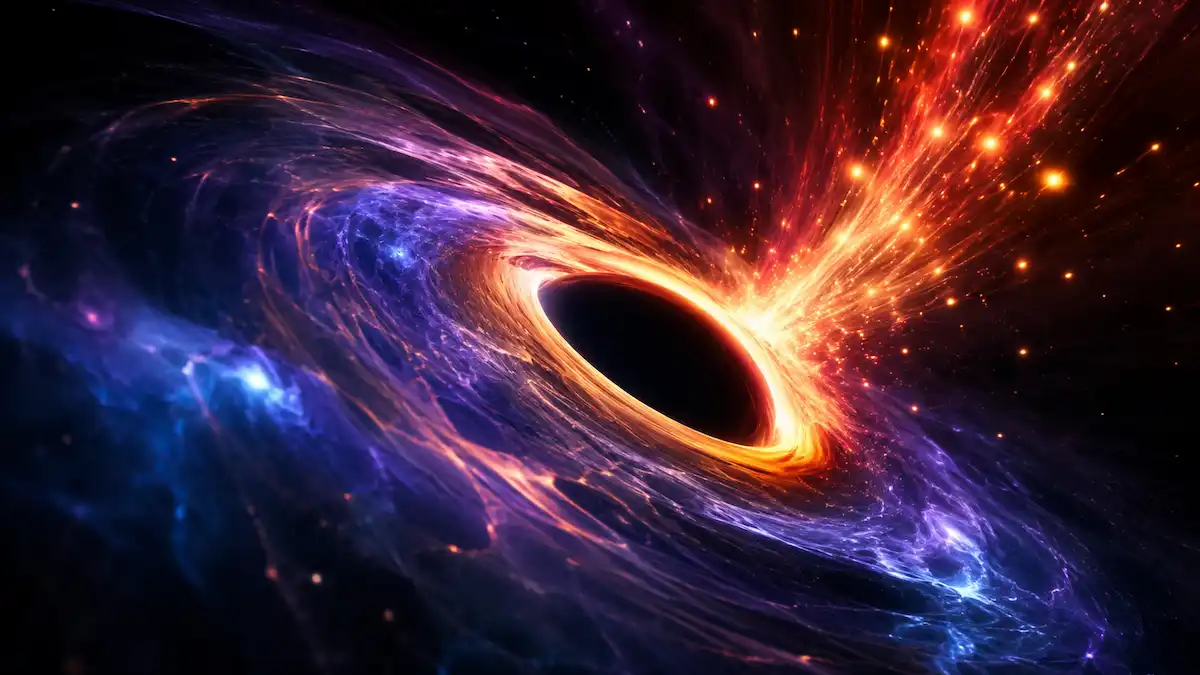
How does Hawking radiation work? The theory begins with an unusual discovery in quantum physics, which is a black hole is not completely black. In 1974, Stephen Hawking suggested that based on quantum theory, a black hole should give off thermal radiation from its event horizon. This Hawking radiation is much weaker for large astronomical black holes, but over long periods of time, it leads to the evaporation of a black hole.
Why Do Black Holes Emit Radiation?
How Does Hawking Radiation Work?
To understand how does Hawking radiation work, it is necessary to briefly explain the physics of the event horizon.
An event horizon is like a boundary around a black hole from which nothing can return. In other words, crossing the event horizon means being trapped in a black hole forever. However, the Hawking radiation does not involve the information or matter from inside the black hole. Instead, it is connected to the quantum theory. The quantum field theory suggests that what we call empty space is not empty at all. It is filled with quantum fields which govern the behavior of the matter at the level of elementary particles. What the observers see depends on the reference frame they are in.
In other words, the theory of empty space depends on the observers’ reference frames. If they are accelerating with respect to each other, or if they are in different gravitational potentials, their perceptions of reality will differ. Near a black hole, spacetime is extremely curved. Hawking’s calculation showed that this curved spacetime changes how quantum fields are perceived by an observer far away. As a result, the observer who is far away from the black hole would see a thermal flux of particles coming from it. This is the Hawking radiation.
What Happens to Quantum Fields Near the Event Horizon?

The deeper explanation of how does Hawking radiation work comes from quantum field theory in curved spacetime. In ordinary physics, we thought particles are small objects moving through empty space. But quantum field theory defines them in different way. It says that particles are the excitations of quantum fields. Like, electron is an excitation of the electron field and photon is an excitation of the electromagnetic field. These fields are present even in the vacuum.
When a massive star collapses and forms a black hole, it produces extremely strong and changing gravitational field. As a result the spacetime around it changes and affects the behaviour of the quantum fields near the event horizon. A quantum field which was present in the vacuum before the formation of a black hole is explained differently by a distant observer after the collapse. The distant observer detected an outgoing flux of particles with a thermal distribution. This is what we call Hawking radiation. This is the mathematical foundation of how does Hawking radiation work.
How Does the Black Hole Lose Energy?
When Hawking radiation moves away from a black hole, it carries some energy with it. So that black hole also loses some of its mass. It happens because mass and energy are directly proportional to each other. According to Einstein’s equation, E = mc², it means if an object loses its energy, it also loses its mass automatically. This makes Hawking radiation much more than just a strange quantum effect. It means in theory, over time a black hole can slowly shrink and evaporate completely. As the black hole loses its mass, its event horizon shrink and the black hole becomes smaller. At the same time, its Hawking temperature increases, causing it to release radiation at a faster rate. The process can be simplified like this:
Hawking radiation carries away energy → the black hole loses mass → its event horizon gets smaller → its temperature rises → radiation becomes stronger.
This process is incredibly slow for a normal black hole that was formed by a massive star. They would take unimaginable long time to lose their mass completely. This peculiar process is called black hole evaporation, and it is one of the most fascinating consequences of Hawking radiation.
Why Smaller Black Holes Are Hotter?

One of the most interesting facts about how does Hawking radiation work is the connection between a black hole’s mass and temperature. Scientists found that Hawking temperature is inversely proportional to the mass, which means that a black hole with more mass is cooler and a black hole with less mass is hotter. For example, according to NASA’s estimations, the black hole with a mass similar to our sun’s would have a temperature of about 10-8 Kelvin, which is nearly absolute zero. Supermassive black holes are even colder. This is why Hawking radiation from a real black hole is not detected yet; the black hole’s temperature is far lower than the temperature of the surrounding space.
The cosmic microwave background (CMB), the leftover radiation from the Big Bang, has a temperature of about 2.7 Kelvin. CMB is much warmer than a black hole, which results in them being net absorbers of energy. Black holes absorb more energy from the surrounding that they lose through Hawking radiation. Therefore, detecting such black holes is exceptionally challenging with our current technology.
Why Black Hole Evaporation Speeds Up Over Time
An interesting part of how does Hawking radiation work is that, a small black hole loses its mass faster. As a black hole emits Hawking radiation, it loses mass. Once its mass decreases, its Hawking temperature rises, which causes the black hole to emit even more Hawking radiation. This results in another decrease in mass for the black hole, which subsequently causes its Hawking temperature to increase further, and so on. The process creates a kind of feedback loop:
Less mass → higher temperature → stronger radiation → even less mass
For stellar mass black holes however, the process would be incredibly slow, as a black hole with a mass of our sun would take on the order of 1067 years to fully evaporate, using Hawking’s radiation. Compared to the current age of the universe being only about 13.8 billion years, this is an incredibly long time. Thus, while the actual evaporation process for a black hole becomes quicker and quicker as the black hole gets smaller and smaller, we should not expect to see any appreciable evaporation from an ordinary stellar-mass black hole during a human lifespan or during the entire history of the universe so far.
What Happens at the End of Hawking Evaporation?
The end state of an evaporating black hole is an open question in theoretical physics. As a black hole loses mass, its Hawking temperature rises, causing it to radiate more and more powerfully, accelerating the evaporation process. This leads to a major problem in theoretical physics, as the most powerful physical laws, general relativity and quantum mechanics, break down at a point of such a small black hole. We know that, general relativity describes gravity with extraordinary precision and, quantum mechanics describes the behavior of matter and energy with unparalleled accuracy. Neither of these physical theories can fully describe the process of black hole evaporation and the state of matter inside a black hole.
Physicists do not yet have a working theory of quantum gravity, which would unite these two pillars of modern physics. The physics of black hole evaporation is well-developed, but theoretical physics cannot answer the question of what happens to a black hole when it evaporates completely. Perhaps, a black hole simply disappears, leaving some unknown remnant.
Conclusion
So, how does Hawking radiation work?
It is a purely quantum effect which is produced by the interaction of quantum fields with the strongly curved spacetime near a black hole. The radiation is not created by processes inside the hole, nor emitted through the event horizon; instead, the formation of the black hole modifies the quantum field vacuum structure in a region of spacetime. This causes to appear a thermal flux of particles for distant observers, the power which can carry off energy from the black hole. Therefore, such a black hole loses mass, shrinks, and becomes hotter. In the end, it evaporates away.
For macroscopic black holes, this process is extremely slow, but it is not negligible over long time scales. Even so, Hawking radiation is an important concept, as it connects the three fundamental pillars of all the physics known to man – quantum mechanics, general relativity and thermodynamics in one single idea.