
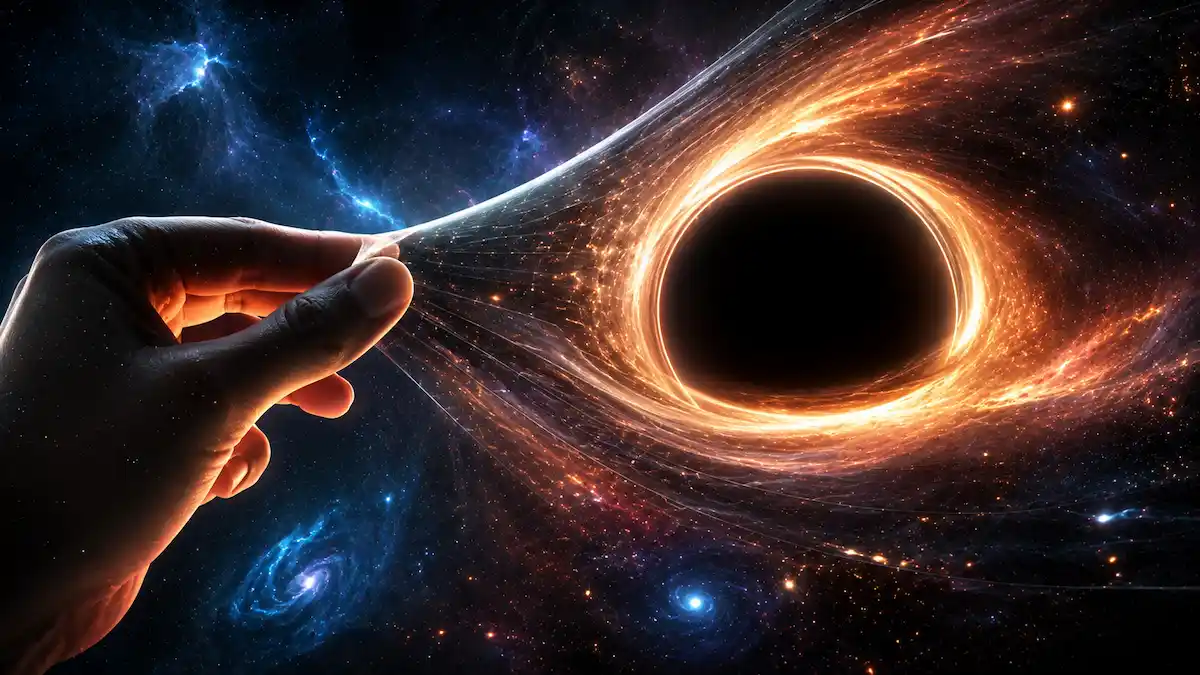
Why do black holes emit radiation? Such a question seems to be not compatible with one of the basic premises about black holes that nothing can escape from it. However, theoretical physics suggests that black holes can emit thermal radiation and lose mass through this process. This type of radiation is called Hawking radiation, which is produced due to quantum field theory in the curved space-time around black holes, not due to the energy from inside the black hole coming out.
Why Do Black Holes Emit Radiation?
The simplest answer to why do black holes emit radiation is that quantum fields exists everywhere, including the distorted space around the event horizon. In 1974, Stephen Hawking said that if we apply quantum field theory to a space-time which contains a black hole, then a distant observer would see a very weak thermal spectrum of radiation emitted by the black hole. This was named as Hawking radiation. It does not mean that particles are literally escaping from the inside of the event horizon. It is like a one-way boundary, from where nothing can get out after crossing it because black hole’s gravity is so strong. Instead, the predicted radiation is produced by quantum effects associated with the region around the event horizon. For distant observer, black hole behaves like it has temperature and is emitting radiation slowly.
To understand how and why a black hole emits radiation, we need to use two different theories of physics, Einstein’s general relativity and quantum field theory.
Why Are Neutron Stars So Dense?
How Does Hawking Radiation Work?

The actual explanation of Hawking radiation is based on the quantum field theory in a curved space-time. Perhaps, you have heard the following version of the explanation for Hawking radiation. Near the black hole horizon, there is a quantum effect called the pair production of virtual particles. One of the pair falls inside the black hole while the other escapes from it, thus, contributing to the black hole radiation. This is a useful way to visualize the idea, but it is not the actual explanation. The real process is more complicated.
According to quantum physics, space is filled with quantum fields. When a star collapses and forms a black hole, the spacetime around it significantly distorts and becomes curved. This affects the behavior of quantum fields. Therefore, different observers, which are located far away from the black hole, experience different space-time structures. Before the black hole forms, an observer may see the fields as being in a vacuum state, meaning there are no ordinary particles being detected. But an observer far away after the black hole has formed can describe those same fields differently. The strong gravity and changing spacetime around the newly formed black hole mix the different states of the quantum fields. When a distant observer measures the outgoing field, they find that it contains particles with a specific thermal pattern. This outgoing energy is what we call Hawking radiation.
So, why do black holes emit radiation? They do not emit particles from inside the event horizon. Instead, the formation of the black hole changes how quantum fields behave and how different observers describe the quantum vacuum. This produces a faint stream of particles that can be detected far away from the black hole.
Why Doesn’t Hawking Radiation Violate the Event Horizon?
This is one of the most important questions surrounding why do black holes emit radiation. If nothing can escape a black hole, how can radiation come out?
The answer is simple; Hawking radiation does not need to escape from inside the event horizon. Instead, Hawking radiation is linked to the behavior of quantum fields in the curved spacetime around the event horizon. The extreme gravity of black hole changes the behavior of the quantum field. As a result, an outgoing flow of particles can be detected far from the black hole. So, the black hole does not actually leak its contents out, but the Hawking radiation is produced by the quantum effects taking place on its event horizon.
Black Hole Temperature Depends on Its Mass
Hawking’s theory also tell us about the temperature of black hole. For a non-rotating, uncharged black hole, the Hawking temperature is inversely proportional to its mass. A black hole with more mass is colder and a black hole with less mass is hotter. A typical stellar-mass black hole has extremely low temperature, around 10-7 Kelvin. This makes its Hawking radiation incredibly weak and almost impossible to detect directly. Through, Hawking radiation black hole loses energy, and also lose mass. This creates a remarkable cycle: less mass means higher temperature, and higher temperature means stronger radiation. This relationship explains well about why do black holes emit radiation and why black hole evaporation becomes faster as the black hole gets smaller.
Why Do Black Holes Evaporate?

Hawking Radiation Can Slowly Destroy a Black Hole. It carries energy away from a black hole. According to Einstein’s famous equation, E = mc², mass and energy are directly proportional to each other. It means that if mass increases, then energy also increases and if mass decreases then energy also decreases. So, when black hole loses energy through Hawking radiation, it also loses some mass of it. This leads to an interesting prediction called black hole evaporation. As a black hole loses mass, its temperature rises. A hotter black hole produces stronger Hawking radiation, which causes it to lose energy and mass even faster. In other words, the process can speed up like this:
Less mass → higher temperature → stronger radiation → faster mass loss
For normal astrophysical black holes, however, this process is very slow. A black hole having mass several times more than the Sun would take roughly 10⁶⁷ years to completely evaporate. This huge duration is even longer than our universe’s current age, about 13.8 billion years. The process of evaporating an extremely small black hole is much faster. During the final stages of evaporation, black hole would reach in such conditions where our current theories and laws of quantum mechanics and gravity would fail and do not able to explain the situation fully. So, in theory, a black hole can eventually disappear—but for ordinary stellar-mass black holes, it would take an unimaginably long time. By understanding this process properly help to know well about why do black holes emit radiation.
Can We Detect Hawking Radiation From Real Black Holes?
Here the theory becomes problematic. Hawking radiation provides is one of the most theoretical predictions, it is extremely challenging to actually observe Hawking radiation from an astronomic black hole, even if they do exist. The temperature of Hawking radiation from a stellar-mass black hole is extremely low to be detected with our current technology.
There is another major problem: space itself is not completely cold. The cosmic microwave background (CMB) has a temperature of about 2.7 kelvin, which is enormously higher than the Hawking temperature of a stellar-mass black hole. This background radiation can easily overwhelm the tiny signal expected from the black hole.
This is why scientists are working on creating simplified black holes in laboratories. By using a liquid or some other medium, scientists can observe the phenomena around an event horizon without actually trying to observe a black hole. These kinds of experiments cannot confirm the existence of Hawking radiation from astronomic black holes, but they allow researchers to investigate related quantum effects in controlled environments.
Final Thoughts
So, why do black holes emit radiation even though nothing can get out of them?
The reason is that some quantum fields were imprinted on spacetime, which Hawking used to calculate that an observer far away from a black hole would see a thermal flux of particles coming out from it. This radiation is called Hawking radiation. The radiation is actually not coming out from the center of the black hole, but rather from the quantum fluctuations in the area of the event horizon, and the curved spacetime around it. Since it takes away the energy in the form of mass, the black hole loses mass over time, and consequently, the temperature of Hawking radiation increases, allowing black holes to evaporate even faster. But for stellar and supermassive black holes, the rate is much slower, so it would take a lot longer than the current age of the universe to evaporate completely.
The deeper significance of why do black holes emit radiation is that it exposes a fundamental boundary in modern physics. The fact that black holes are such strange objects, from which not even light can escape, but still emit radiation is why quantum mechanics and general relativity need to be unified. This would allow us to understand what exactly happens at the border between the two, and what goes on there, since both of these physical theories are not consistent with each other.
YOU MAY LIKE
- Milky Way’s Black Hole Is Slowly Destroying Itself to Power Cosmic Rays”
 Milky Way’s black hole may be doing something scientists never expected. It is sacrificing a piece of itself to power some of the most energetic particles in our galaxy. A theoretical study suggests that Sagittarius A*, the supermassive black hole present at the center of the Milky Way, could be using its own spinning energy… Read more: Milky Way’s Black Hole Is Slowly Destroying Itself to Power Cosmic Rays”
 - New Tesla Roadster Takes Flight — But Elon Musk’s Original Car Is Still in Space
 This week, Tesla Roadster comes twice in the news for two very different reasons. On October 15, 2026, Tesla showed off a new Roadster prototype in Texas that appeared to lift off the ground using thruster technology inspired by SpaceX. While the new Roadster was making headlines on Earth, the original red Tesla Roadster that… Read more: New Tesla Roadster Takes Flight — But Elon Musk’s Original Car Is Still in Space
 - Astronomers Find the First Green Star – Could Our Sun Also Glows Green After it Dies?
 Astronomers just found the first green star and the reason of its unusual color is surprising. Astronomers at the University of Warwick have detected a dead star that actually looks green to the human eye, something that never confirmed before research. Scientists believe that the star has gained this green color because it consumes some… Read more: Astronomers Find the First Green Star – Could Our Sun Also Glows Green After it Dies?
 - Microblazar Discovered In Our Galaxy, After 30 Years of Searching And Its Jet Is Pointed Straight At Earth
 Recently a microblazar has been confirmed in our own galaxy, Milky Way. Scientists have been investing this cosmic mystery for nearly 30 years. The study reveals that the object named IRAS 18293-0941 sits about 1200 light years away from Earth and one of its powerful jets points straight towards the Earth. It sounds danger but… Read more: Microblazar Discovered In Our Galaxy, After 30 Years of Searching And Its Jet Is Pointed Straight At Earth
 - Orionid Meteor Shower: The Ancient Shooting Stars That Left By Halley’s Comet Centuries Before You Were Born
 The Orionid Meteor Shower returns this month, and brings beautiful streaks of lights and fill the dark sky with colours. Each meteor burning up in the sky is a tiny piece of dust that left behind by the Halley’s Comet hundreds of years ago. Now centuries past, and when Earth passes through this old trail… Read more: Orionid Meteor Shower: The Ancient Shooting Stars That Left By Halley’s Comet Centuries Before You Were Born