
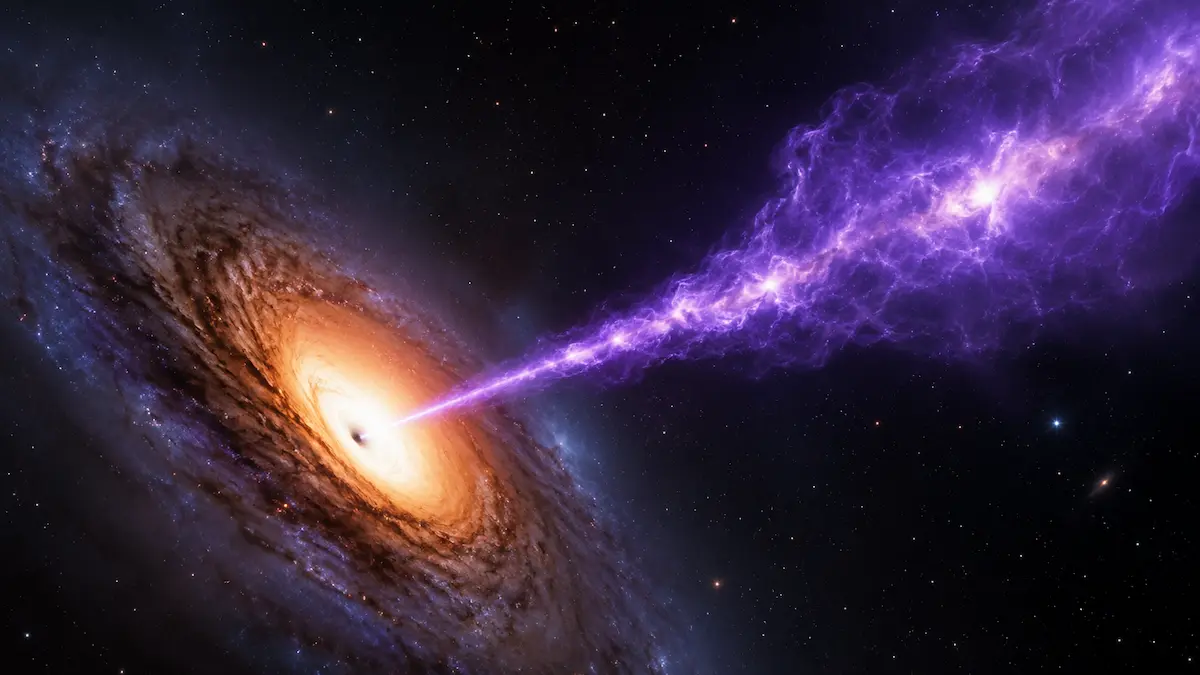
Messier 87 black hole jet is one of the most powerful and mysterious objects ever found in the universe. Astronomers have studied this energy for many years, and trying to understand how can a black hole shoot matter through space at incredible high speed (nearly the speed of light). In 2019, the world saw the first-ever image of a black hole. That black hole was located at the center of the giant galaxy, named Messier 87 (M87). That image became very popular and it only showed the black hole’s shadow. But it also contains another interesting feature that shocked scientists—the enormous jet of superheated particles shooting out from its center.
Now, NASA’s Chandra X-ray Observatory has revealed the most detailed X-ray view ever captured of the Messier 87 black hole jet. This data helps scientists to understand how this giant cosmic beam is powered, and why parts of it appear brighter than others, and how it manages to stay stable over thousands of light-years. These new discoveries are now changing the astronaut’s opinion about black holes.
Early Stage Of A Star, Protostar.
What Is the Messier 87 Black Hole Jet?
The Messier 87 black hole jet is a huge stream of extremely hot particles and powerful magnetic fields. It shoots out from the center of the galaxy Messier 87, and also known as M87.

Messier 87 is a massive elliptical galaxy that is located about 55 million light-years away from the Earth in the Virgo Cluster. It contains one of the largest black holes ever observed at its center. Scientists estimate this supermassive black hole has a mass of about 6.5 billion times greater than our Sun. Black holes pulls everything inside that crosses the boundary called event horizon (also called no return point). But something remarkable happens before material reaches that point. Gas, dust, and even entire stars that get too close begin swirling around the black hole instead of falling directly inside. This spinning material forms a superheated structure called an accretion disk.
Inside this disk, temperatures rise to millions of degrees. Powerful magnetic fields twist and interact with the rapidly spinning gas, creating enormous amounts of energy. Some of this material never falls into the black hole. So part of it is accelerated away from the black hole’s poles at speeds nearly the speed of light, and scientists named them Messier 87 black hole jet.
How Big Is the Messier 87 Black Hole Jet?
The most shocking part is the size of Messier 87 Black Hole Jet. The visible jet stretches for about 5,000 light-years, but scientists believe the entire structure is much larger. If we include its faint outer region, it stretches over 100,000 light-years out into space. To understand how enormous that is, our entire Milky Way galaxy is about 100,000 light-years across. In other words, the Messier 87 black hole jet is almost as long as our entire galaxy. This makes it one of the most powerful and longest-lasting particle beams ever observed in nature.
NASA Chandra Observatory’s Latest Discovery That Excited Scientists
Scientists have studied the Messier 87 black hole jet for many years by using radio telescopes, optical observatories, and space telescopes. But in 2026, NASA’s Chandra X-ray Observatory gives most detailed X-ray images of the jet. Unlike visible light, X-rays reveal the highest-energy particles moving through the jet. Scientists created an extremely sharp X-ray image that showed details never seen before by combining all the gathered information over these years.
New observation reveals that different parts of the jet behave differently. Some regions produce strong X-rays, showing where particles are being accelerated to incredible energies. Other areas are much calmer, which suggests the jet is powered by more than one physical process. Scientists also tracked how bright knots inside the jet changed over time. These changes help researchers to understand how magnetic fields control the jet and how energy moves through it over thousands of light-years.
What Scientists Found Inside the Jet
The new Chandra observations revealed that the Messier 87 black hole jet is far more active than it appears from a distance. Instead of behaving like one continuous stream of energy, the jet is made up of several smaller regions that each plays a different role. Some areas are packed with extremely energetic particles, while others appear to be cooling down after releasing their energy. Scientists also noticed that these regions are not permanent. Over time, some become brighter while others fade away, showing that the jet is constantly changing as energy flows through it. This suggests the jet is not powered by a single event near the black hole but by ongoing processes that continue to accelerate particles as they travel through space.
These findings give astronomers a much clearer picture of how the Messier 87 black hole jet remains active across thousands of light-years. They also provide valuable clues about the role of magnetic fields and high-energy particles in shaping one of the most powerful cosmic structures ever discovered.
Conclusion
The Messier 87 black hole jet is one of the most extraordinary objects ever discovered in the universe. It is not a simple beam of light, actually it is a powerful stream of particles traveling at incredibly high speed, and powered by a supermassive black hole that is 6.5 billion times more massive than our Sun.
The latest observations from NASA’s Chandra X-ray Observatory helped scientists to understand these jets more clearly. They revealed hidden structures, energetic hotspots, and new clues about how jet travels across thousands of light-years. These discoveries are helping astronomers to understand the objects that remain mysteries for decades. And they also raise new questions like how black holes interact with the nearby galaxies. After all these efforts, Messier 87 black hole jet still holds many secrets. Scientists believe that future observatories and next-generation telescopes uncover even more details about these mysterious cosmic jets, how they form and why they remain stable over such vast distances.
If you are a space lover then, stay connected with Science Scope Hub for more interesting space stories and mysteries.
.