
What is a protostar? It is one of the most interesting questions in astronomy because it takes us to the very beginning of a star’s life. In simple terms a protostar is a young star that is still forming. Before a star starts producing its own light and heat through nuclear fusion, it goes through an early stage called a protostar. This is the first major step in the life of every star.
Understanding what is a protostar means understanding how stars are born. Everything begins inside a giant cloud of gas and dust. Over time, gravity pulls this material together. As the cloud collapses, the center becomes hotter, denser, and brighter. This is a very slow process; it can take hundreds of thousands of years to grow the young star and finally ready to shine. One reason why scientists could not reveal what is a protostar for so long because protostars are hidden inside thick clouds of dust. These dusty cocoons block visible light, and making it almost impossible to see by human eyes or even ordinary telescopes. For many years, astronomers could only imagine what happened during the birth of a star. But James Webb Space Telescope launch changed everything. It has powerful infrared instruments that can see through thick dust clouds, and help scientists to observe the hidden objects in detail. Thanks to these observations, what is a protostar is no longer just a theory. Scientists can now watch some of the earliest stages of star formation and learn more about how stars like our Sun begin their journey through the universe.
How Neutron Star Merger can create every piece of gold present on earth far in space.
What Is a Protostar — The Simple Explanation
To understand what is a protostar, we first need to know the origin of stars.
The journey of a star life starts inside huge clouds of gas and dust called molecular clouds. These clouds are extremely cold, with temperatures as low as 10 Kelvin (about -260°C or -440°F). They can remain quiet and unchanged for millions of years. Until something don’t disturb them. It could be a nearby star explosion, the movement of a spiral arm in the galaxy, or the collision of two clouds. Whatever the cause, it makes the cloud unstable, and then gravity starts pulling the gas and dust together. As gravity starts working, the cloud breaks into smaller and denser clumps. These clumps keep shrinking until they form even smaller regions called cores. Each core has the potential to become a new star. As the cores collapse they start spinning faster. The spinning gas and dust form a flat disk around the center, while more material continues to fall inward. As this material builds up, the center becomes hotter and denser. At this stage heat comes from gravity squeezing the gas together, not from nuclear fusion. This hot, growing object is called a protostar.
The best way to understand what is a protostar imagine it as a baby star. It is no longer just a cloud of gas and dust, but it is not yet a true star either. At this stage its core is still not hot enough to start nuclear fusion. This process allows stars to produce their own light and energy. Instead, a protostar shines because gravity creating heat by compressing it constantly as it grows. This early stage is one of the most exciting parts of a star’s life. A protostar can remain in this stage for about 100,000 years for very massive stars, or more than one million years for stars like our Sun, it is totally depends on the size.
In simple words, what is a protostar? It is a young star that is still growing and getting ready to become a fully formed star.
What Does a Protostar Look Like?

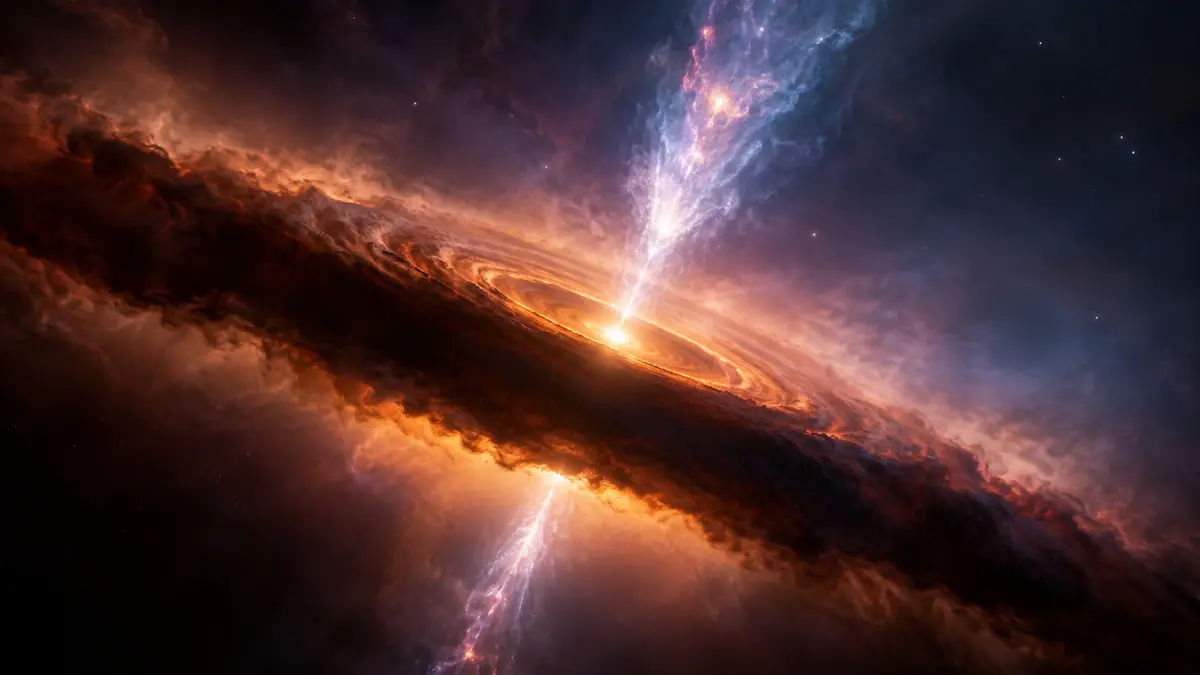
If you’re wondering what is a protostar, it also helps to imagine how it looks like. A protostar sits at the center of a large spinning disk made of gas and dust. This disk is called a protoplanetary disk. It contains the remaining material that did not fall into the growing star. These tiny dust particles kept inside this disk stick together for millions of years and slowly grow into rocks, asteroids, and even planets. One of the most amazing features of a protostar is the powerful jets it sends into space. Protostar shoot these jets from the top and bottom at incredibly high speed. As they travel through the surrounding cloud, they push away gas and dust, creating giant hourglass-shaped cavities.
The James Webb Space Telescope has captured some of the clearest images of these jets. In infrared light, they appear as beautiful glowing streams of blue, orange, and red stretching far into space. These stunning images have helped scientists to know better what is a protostar and how young stars grow. The protostar itself is usually hidden deep inside thick dust clouds.
One of the best-known examples is L1527, a young protostar located about 460 light-years away in the Taurus star-forming region. The James Webb Space Telescope photographed L1527 in incredible detail. The image looks like a glowing cosmic butterfly, with bright blue and orange clouds spreading outward from a dark center where the protostar is hidden. Scientists believe L1527 is a Class 0 protostar, the earliest stage of star formation, and it is only about 100,000 years old. Today, images like L1527 give us one of the clearest answers to what is a protostar.
The 4 Stages of Protostar Formation

Understanding what is a protostar becomes much easier when you know about its whole journey. Every star goes through several stages before it fully grow and start producing its own energy through nuclear fusion.
Stage 1 – Molecular Cloud
Everything begins inside a molecular cloud, a huge cloud of cold gas and dust floating through space. These clouds are extremely cold, with temperatures close to absolute zero. They can remain almost unchanged for millions of years and slowly move through the galaxy. Even though they seem calm, gravity is constantly acting on them.
Stage 2 – Cloud Collapse
The next stage starts when something disturbs the cloud. A nearby supernova explosion, the collision of two gas clouds, or the movement of a spiral arm in the galaxy can trigger the collapse. Once gravity takes over, parts of the cloud begin shrinking. The cloud breaks into smaller, denser regions called cores. These cores continue pulling in more gas and dust from the surroundings, growing larger and hotter as they collapse.
Stage 3 – Protostar
As the core becomes hotter and denser, a protostar forms at its center. This is the stage that answers what is a protostar most clearly. A protostar is a young star that is still growing. It start shines because gravity is compressing it and creating heat, but its core is not yet hot enough to start nuclear fusion. A spinning protoplanetary disk forms around the protostar, while powerful jets shoot out from its poles. At the same time more gas and dust constantly falling onto the protostar and helping it to gain more mass. This is one of the most active and exciting stages in the life of a star.
Stage 4 – T Tauri Star (Pre-Main-Sequence Star)
Eventually, most of the surrounding gas and dust disappear. The young star stops collecting large amounts of material and starts shrinking under its own gravity. As it contracts, the temperature inside its core continues to rise. This stage can last tens of millions of years for a star like our Sun. When the core temperature reaches about 10 million Kelvin (around 18 million°F), hydrogen fusion finally begins. At this moment, the protostar becomes a true star. It start producing light and heat that can continue for billions of years. This is the final step in the journey that explains what is a protostar—it is the important stage between a collapsing cloud of gas and a fully formed star.
Conclusion
So, what is a protostar? Simply understand it is a young star that is still growing before it becomes a fully formed star. It is one of the most important stages in a star’s life, where gravity slowly turns a cold cloud of gas and dust into a fully grown shining star.
This process is not quick. A protostar needs hundreds of thousands to more than a million years o becomes a fully grown star that produce its own light and heat through nuclear fusion. For a long time, the formation of stars was unknown to scientists. They could only imagine how stars were born because protostars were hidden inside thick clouds of dust. Ordinary telescopes could not see through these dusty cocoons. Everything was changed when James Webb Space Telescope comes in action. It has powerful infrared cameras that can look through the dust and capture detailed images of young stars. Thanks to Webb, scientists can now watch jets shooting into space, spinning disks where future planets may form, and the earliest stages of a star’s life. Understanding what is a protostar also helps us to know about our own origin. Billions of years ago, our Sun was also once a protostar. Every star that we see in the night sky began its journey in the same way. The next time when you look up at the stars, remember that each one started as a small, hidden protostar inside a huge cold cloud of gas and dust. The universe has been creating stars like this for more than 13 billion years, and even today, new protostars are forming in distant galaxies, continuing the incredible cycle of cosmic creation.
Stay connected with Science Scope Hub for more exciting space discoveries and mysteries.
Pingback: Messier 87 Black Hole Jet: Scientists Just Discovered Something That Shouldn't Be Possible