
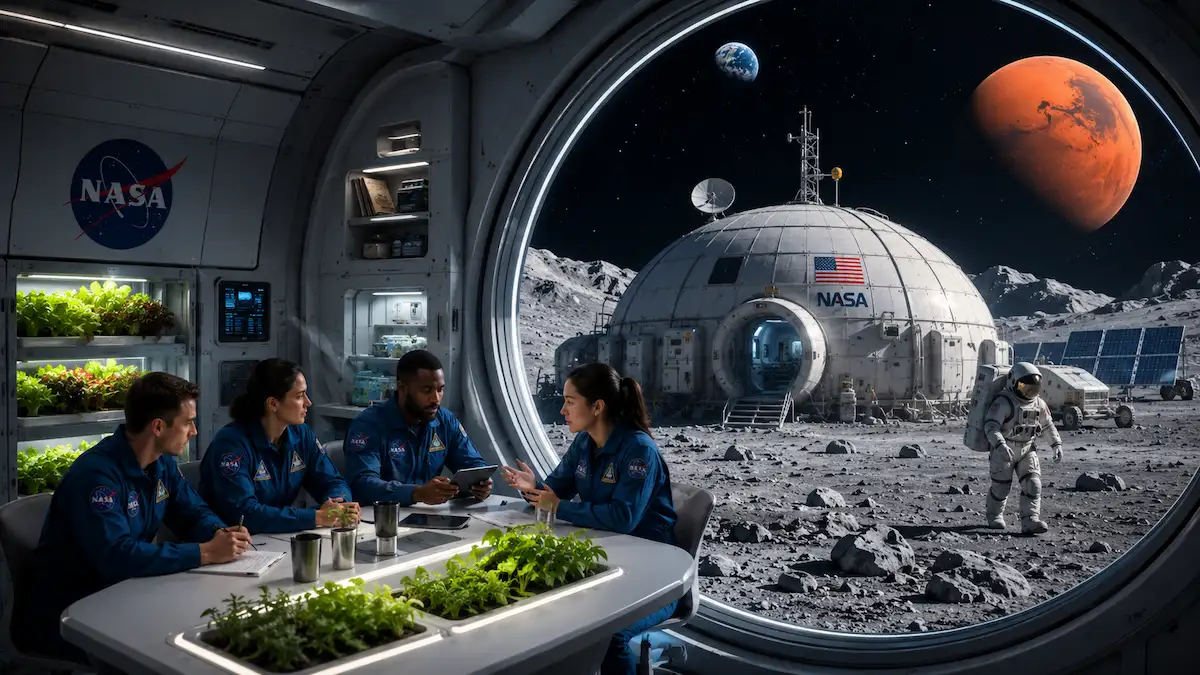
NASA moon and Mars simulation mission has just opened applications, giving people a rare chance to experience life like an astronaut without leaving Earth. NASA is recruiting 4 volunteers to live inside a specially designed habitat for 1 year at the Johnson Space Center in Houston, Texas. During this mission volunteers will grow food on their own, carry out scientific experiments, handle simulated emergencies, and follow a schedule just like astronomers do on future Moon and Mars missions. But the difference is volunteers will remain on earth, they do not leave the planet. This mission is designed to recreate the challenges of living in deep space. The best part is selected volunteers will also receive a certain payment for participating in the mission. In this article, you’ll learn everything about the NASA Moon and Mars simulation mission. Including all about the selection process and why NASA is conducting this important research for future exploration of the Moon and Mars.
What Is the NASA Moon and Mars Simulation Mission?

The NASA Moon and Mars simulation mission is officially called the Moon and Mars Exploration Analog (MMEA). This new research program combines NASA’s two previous human spaceflight studies, first is Human Exploration Research Analog (HERA) and second is Crew Health and Performance Exploration Analog (CHAPEA). This makes the mission unique. In the past, NASA’s analog missions usually focused on only one part of a space journey. Some missions simulated the long trip through deep space, while others focused on living and working on the surface of the Moon or Mars. The NASA Moon and Mars simulation mission is the first ground-based study that combines both phases into a single mission. Volunteers will first experience the challenges of traveling through deep space and then transition to life inside a simulated Moon or Mars habitat. This allows NASA to study how people adapt to long periods of isolation, limited resources, teamwork, and the physical and mental challenges of future deep-space missions.
In simple terms, instead of practicing only the journey or only life on another world, the crew will experience both as part of one year-long simulation. This helps NASA to prepare astronauts for future missions beyond Earth. The NASA Moon and Mars simulation mission is expected to begin no earlier than August 2027. Before the mission starts, NASA will spend several months for selecting, testing, and training the four volunteers who will take part in this mission.
Moon lava tubes could become astronauts base in future deep space missions.
What Will Volunteers Actually Do?

The NASA Moon and Mars simulation mission is not only spending a year inside a building. It is designed to recreate the experience of a real mission to deep space, including living on another planet. For one full year, the four selected volunteers will live and work in complete isolation. During this time, they will simulate both interplanetary travel and planetary surface operations, including simulated spacewalks. The mission is divided into two main phases.
Phase 1: Simulated Deep Space Journey
The first phase takes place inside the same habitat that was used for NASA’s HERA program. This two-story habitat acts as a simulated spacecraft that give experience of traveling from Earth to the Moon or Mars. Inside this habitat, volunteers will have a workspace, living area, sleeping quarters, and a hygiene module. They will live there as they are present in deep space millions of miles away from Earth, dealing with similar communication delays, limited supplies, and no one will leave the spacecraft until this phase is complete.
Phase 2: Simulated Moon or Mars Surface
In this phase volunteers will move into a different habitat that is currently used for NASA’s CHAPEA program. This one-story, 3D-printed habitat is designed to simulate life on the surface of the Moon or Mars. It includes private sleeping quarters, a shared workspace, a recreation room, an area for growing crops, a medical room, a food preparation area, an airlock, two bathrooms, and a large sandbox where volunteers can practice simulated planetary walks.
The crew may also use a rover module to simulate traveling and exploring the sites that are away from the main habitat. The rover has two driver seats, two beds, a non-flushable toilet, and a small airlock for handling collected samples.
Daily Tasks during the Mission
In both phases of the NASA Moon and Mars simulation mission, volunteers will perform almost the same activities that future astronauts may do on real missions. Their daily tasks are as follows:
- Growing and taking care of food crops.
- Conducting scientific experiments.
- Responding to simulated emergencies.
- Practicing planetary walks on a large sandbox.
- Repairing and maintaining equipment.
- Following Mars time, where one day is about 40 minutes longer than a day on Earth.
Isolation is one of the most challenging parts of the NASA Moon and Mars simulation mission. Volunteers will have very limited communication with the outside world, and also do not have any connection with social media. This helps NASA to study how astronauts deal with loneliness, communication delays, and long periods away from family and friends during future Moon and Mars missions.
Who Can Apply? The Requirements
Not everyone can apply for the NASA Moon and Mars simulation mission. Since this study is very important and designed to prepare astronauts for future deep-space missions, NASA has set several eligibility requirements. To apply, you must be a U.S. citizen or a permanent resident (Green Card holder). Age requirement is between 30 and 55 years old.
There are also some physical requirements. Applicants must be no taller than 74 inches (6 feet 2 inches), be fluent in English, and be willing to commit to about 14 months. This includes 12 months living inside two different simulated space habitats, along with two months of training and post-mission research activities. Everyone applying for the NASA Moon and Mars simulation mission must also take part in a multi-day selection process and successfully pass NASA’s physical and psychological test.
Participants must have strong educational background. Applicants must have a bachelor’s degree from an accredited institution in engineering, biological science, physical science, or mathematics. They also have not any sleepwalking problem or not using sleeping medications, as these could affect the mission. These requirements help NASA to choose volunteers who can safely handle the physical, mental, and technical challenges of living in isolation for an entire year.
How to Apply?
If you are interested in joining the NASA Moon and Mars simulation mission, you can apply through NASA’s official analog studies program. If you have any questions about the application process, you can also contact the recruitment team by email at jsc-analog-application@mail.nasa.gov . The official application is available through NASA’s analog studies website. The selection process includes multiple stages, starting with application review. After then shortlisted applicants will be invited for a multiday in-person selection process, physical and psychological evaluations. NASA is looking for people who enjoy unique challenges and want to contribute to the future of human space exploration. NASA is preparing for long-term missions to the Moon and eventually the first crewed mission to Mars.
Conclusion
The NASA Moon and Mars simulation missionis one of the most exciting research programs currently offered by NASA. It gives ordinary people a rare chance to experience life similar to future astronauts. It also helps scientists to prepare for long-duration missions beyond Earth. Only four volunteers will be selected for this year-long mission. During the mission, volunteers will grow their own food, conduct scientific experiments, respond to simulated emergencies, live on Mars time, and spend 12 months inside specially designed simulated habitats that recreate the challenges of travelling in deep space and living on the Moon or Mars. The information collected during the mission will help NASA to improve the safety and success of future deep space missions.
If you meet the criteria and have a passion for space exploration, then NASA Moon and Mars simulation mission provide an once-in-a-lifetime opportunity. While the selection process will be highly competitive, those chosen will play an important role in the future deep space exploration.
Pingback: SpaceX Starship Flight 13 Faces Its Biggest Test Yet With 20 Starlink Satellites