
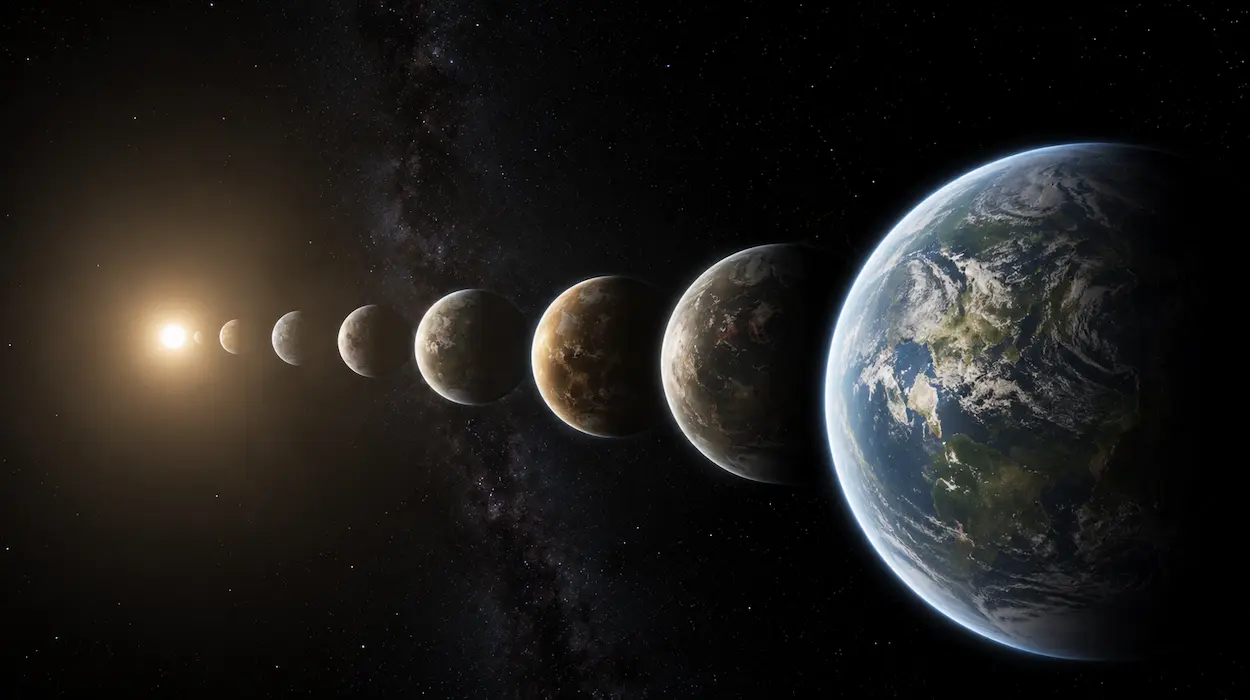
For many years scientists are attracted by nearest habitable planets. Are we alone in the universe, or is there another world where life could exist?
By using modern powerful telescopes, astronomers have now discovered thousands of planets outside our solar system. But few of them orbit within the “habitable zone”. It is a region where temperatures may allow liquid water to exist. But there is not any confirmed evidence that prove that these planets have life. That does not mean these planets are confirmed to have life. Instead, it means they have some of the right conditions that could make life possible. Today, scientists are studying these distant worlds in search of any sign of water, oxygen, methane, and other gases that may reveal whether any of them could support life.
The discovery of the nearest habitable planets has become one of the biggest goals in modern astronomy. Every new discovery brings us one step closer to answering one of humanity’s oldest questions: “Are we really alone?” Let’s explore seven of the most promising worlds discovered so far.
What Does “Habitable” Really Mean?

Before looking at the nearest habitable planets, it is important to understand what the word habitable actually means.
Many people think a habitable planet means a planet similar to the earth. But that is not true. In astronomy, if a planet revolves around its star at a distance where temperatures could allow liquid water to exist on its surface, then it is called potentially habitable. And the region of a habitable planet is called habitable zone or the “Goldilocks Zone”. If a planet is too close to its star, water would quickly evaporate. If it is too far away, water would freeze into ice. The habitable zone is the area where temperatures may be “just right.” But still there is no guarantee that life exists inside this zone.
Scientists must also consider many other factors, including:
- The planet’s atmosphere
- Surface pressure
- Magnetic field
- Size and mass
- Radiation from its star
- Whether liquid water actually exists
That is why the nearest habitable planets remain exciting possibilities rather than confirmed Earth-like worlds.
How exoplanets are discovered?
1. Proxima Centauri b
In the list of nearest habitable planets, Proxima Centauri b is always the first name mentioned. It is located about 4.24 light-years from Earth; it is the closest known potentially habitable exoplanet. It revolves around a star called Proxima Centauri. This star is the nearest star from our sun. Scientists believe Proxima Centauri b is slightly larger than Earth and probably have a rocky surface.
The main part is it revolves under habitable zone around its star. But there is a problem. Proxima Centauri is a red dwarf star, and red dwarfs are extremely active. They regularly produce powerful solar flares that could strip away a planet’s atmosphere over time. If that happened, it is much difficult for life to exist on its surface. Still, Proxima Centauri b remains one of the best places for searching life because of its close distance.
2. TRAPPIST-1e
In 2017, one of the biggest discoveries came to known. Scientists found seven Earth-sized planets orbiting a small star called TRAPPIST-1. But among them only TRAPPIST-1e is considered the most promising one. It is located about 40 light-years away. TRAPPIST-1e is very similar in size to Earth and receives nearly the same amount of energy from its star. So that scientists believe it many have temperature suitable for liquid water. Recently James Webb Telescope helps scientists to study planets around TRAPPIST-1 more closely. But we do not have any evidence of life yet. TRAPPIST-1e continues to rank among the nearest habitable planets worth studying.
3. LHS 1140 b
LHS 1140 b is another fascinating world on the list of nearest habitable planets. It is located about 49 light-years away from Earth. Unlike many other planets, LHS 1140 b appears to be a super-Earth, meaning it is larger and heavier than our planet. Scientists believe it may contain thick atmosphere that helps to keep temperature stable. Some recent studies even suggest it could have a large ocean covering part of its surface. If these ideas are confirmed, LHS 1140 b could become one of the most promising places to search for extraterrestrial life.
4. Teegarden’s Star b
Teegarden’s Star b was discovered in 2019. It attracts scientist’s attention quickly because it looks like earth. It is located about 12.5 light-years away. Scientists estimate it receives almost the same amount of energy from its star as Earth receives from the Sun. Its size is also very similar to Earth’s. These similarities make Teegarden’s Star b one of the most interesting nearest habitable planets discovered so far. Still scientists so not know much about its atmosphere. Without that information, it is impossible to know whether the planet could actually support life.
5. Ross 128 b
Ross 128 b is another exciting planet on the list of nearest habitable planets. It is about 11 light-years away from Earth, making it one of our closest planetary neighbors. Ross 128 b revolves around a red dwarf star. But this star produces far fewer powerful flares than Proxima Centauri. Scientists believe Ross 128 b is slightly larger than Earth and may have temperatures suitable for liquid water. Although we still do not know what its atmosphere looks like, it remains one of the best targets for future space telescopes.
6. TOI-700 d
It is discovered by NASA’s Transiting Exoplanet Survey Satellite (TESS) and it quickly became one of the most talked exoplanets. It is located about 100 light-years away from earth. Even though it is farther than some other planets, astronomers still consider it one of the most promising nearest habitable planets because it is very similar in size to Earth and orbits safely inside its star’s habitable zone. Scientists have already used the James Webb Space Telescope to begin studying planets in the TOI-700 system. In future scientists may reveal whether TOI-700 d has an atmosphere and whether it contains gases which have possibility for life to exist.
7. Wolf 1069 b
Wolf 1069 b is the newest additions to the list of nearest habitable planets. It is around 31 light-years away from the Earth and it was announced in 2023. Scientists believe that it has rocky surface and its mass is similar to earths. It receives light from its star about 65% of the sunlight that Earth gets from the Sun. It orbits inside its star’s habitable zone. Scientists think this world could have liquid water if it has a stable atmosphere. Although we don’t have much information. Wolf 1069 b has become another exciting world in the search for life beyond our solar system.
Conclusion
The nearest habitable planets remind us that our solar system is only one small part of a much larger universe. Scientists have already discovered thousands of exoplanets, but only few have conditions that might support life. From Proxima Centauri b to Wolf 1069 b, these fascinating worlds are giving astronomers exciting new places to explore new things. Yet we don’t have any evidence from any planet that support that proves any planet could support life. But observation brings us closer to understanding whether Earth is unique or just one of many living worlds in our galaxy. As telescopes become more powerful and technology continues to improve, the next big discovery may not be another planet. It could be the first real evidence that we are not alone. Stay connected with Science Scope Hub for more space stories and mysteries.
FAQ
What are the nearest habitable planets?
The nearest habitable planets are nearby exoplanets that orbit within the habitable zone of their stars, where liquid water could potentially exist.
Which is the closest potentially habitable planet?
Proxima Centauri b is the closest potentially habitable planet. It is located about 4.24 light-years from Earth, and it is currently the closest known potentially habitable exoplanet.
Have scientists found life on any habitable planet?
No, scientists have not confirmed life on any exoplanet. They are still studying their atmospheres and environments for any possible signs of habitability.
Why is the habitable zone important?
The habitable zone is the region around a star where temperature is in right conditions which may allow liquid water to remain on a planet’s surface.
Which telescope studies habitable planets?
The James Webb Space Telescope is one of the most advanced space observatories for studying the planet’s atmospheres of potentially habitable exoplanets.