
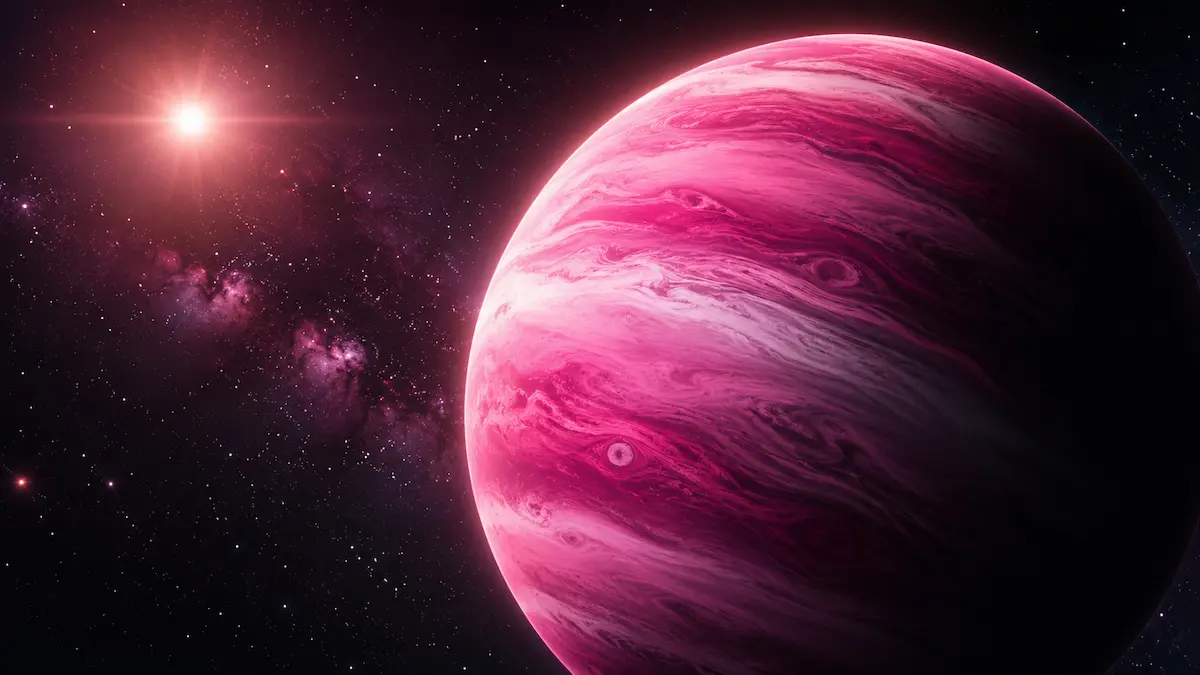
There is a strange pink planet exist in the space. It is located about 57 light years away from the earth. Scientists gave it nickname “pink planet” because it glows like dark cherry blossom in dark space. Scientists discovered it in 2013, about 13 years ago. They observe it for over a decade, by using the world’s most powerful ground based telescope, but they couldn’t understand what it was made of.
Then in June 2026, James Webb Space Telescope observe pink planet for two hours and collected more detailed information. It exposed a secret in front of everyone that was hidden over 13 years. The researchers found that “the pink planet atmosphere contains clouds made of salt particles.” it was something that nobody had expected and never been seen in any planet before.
What Is The Pink Planet?
The pink planet’s official name is GJ 504. It is mouthful so that scientists prefer it by calling pink planet. It is one of the strangest worlds beyond our solar system, scientists ever found. It orbits a sun like star called GJ 504 in the constellation Virgo. It is located about 57 light years away from us. It’s a gas giant just like Jupiter. But both have a major difference in their appearance. Jupiter looks orange and brown but the pink planet glows in shades of deep rose and magenta. NASA has described that it isn’t simply glow by reflecting star’s light. It is actually producing some light of its own. It still glows with leftover heat of its formation. This heat was trapped inside it since its birth billions of years ago. You can relate it by a piece of charcoal that releases heat for a long time after the fire was gone.
Its surface temperature is about 550°F (290°C). It would be unbearably hot on earth. But for a gas giant, it is cool. Scientists observe that mostly gas giants have 1000°F to 2000° or even high temperature. Pink planet has cold temperature as compare to other gas giant planets. It makes the pink planet even more interesting to researchers.
The Discovery – How Scientists Photographed An Alien World In 2013

Most planets that scientists detect outside of our solar system are never actually seen. Scientists develop some indirect methods to detect distant worlds. Scientists observe planet’s nearby star’s light. When a planet passes in front of its nearby star, it blocks some star’s light, creating small dips in star’s brightness. These small dips confirm the existence of a planet around that star. Scientists used same method to found pink planet. Mostly astronomers can only detect the presence of distant world, they never able to take its real image. But pink planet is different, scientists managed to take some actual images of pink planet.
Astronomers captured its real images in 2011 by using Subaru Telescope, a powerful 8.2 meter telescope, operated by the National Astronomical Observatory of Japan, and located at the top of Mauna Kea in Hawaii. Scientists used a technique called direct imaging to capture these images. In this technique, scientists used a special instrument called coronagraph which blocked most of the star’s bright light and allowing to observe much fainter objects orbiting around it. At first astronomers had to confirm that it was really a planet. A team led by researcher Masayuki Kuzuhara spent 2012 to confirm what they had found. After verifying that the pink object appears in mage is really orbiting the stars. Their discovery paper was submitted to The Astrophysical Journal in 2013 and published in September of that year.
After the official announcement, it attracted the global attention. It wasn’t just because of its color but also for the science. At that time GJ 504b was the lowest mass planet ever directly imaged around a sun like star. To capture a actual image instead of only detecting the presence of a distant world is extremely difficult. So it was the very big achievement for space science.
13 Years Of Failure – Why Nobody Could Read Its Atmosphere

After the discovery in 2013, scientists from all over the world tried to study the atmosphere of the pink planet. They wanted to know what its atmosphere was made of. In their research they used a technique called spectroscopy. This technique splits the light into its component wavelength to identify which elements are present. Every gas leaves a unique pattern in that light, allowing scientists to identify the chemicals in the atmosphere. In this process the problem was the pink planet itself.
Aneesh Baburaj, who would eventually lead the James Webb study, explained that “previous astronomer teams observe the planet for entire nights by using powerful telescopes but still they could not get any useful information to analyze the planet’s atmosphere. The biggest problem was the planet’s temperature. GJ 504b is one of the coldest gas giant planets. The cold nature of pink planet makes it much fainter in infrared light – the wavelength that scientists use to study planet’s atmosphere. Because of these challenges ground based telescopes kept coming up empty.
After 13 years, the pink planet was finally ready to reveal its mystery that was hidden inside its atmosphere all along.
Two Hours Vs Thirteen Years – James Webb Changes Everything

In June 2026, everything changed. Aneesh Baburaj and his team at Northwestern University observed the GJ 504b by using NASA’s James Webb Space Telescope (JSWT). This observation lasts only about 2 hours.
Only in 2 hours Webb did it, that world’s largest ground based telescopes had tried for 13 years. It’s easy for Webb because earth’s atmosphere blocks and distorts some amount of infrared light that makes objects difficult to study. Webb did it by operating above earth’s atmosphere; it avoids that problem completely and captures the detailed infrared wavelengths from distant world. Webb also has the ability to block a star’s light with exceptional precision, isolating the faint glow of the planet beyond. When Baburaj’s team receive the data, they immediately knew were looking at something interesting. The data showed a rich chemical mix inside the pink planet’s atmosphere, including water vapor, methane carbon dioxide, ammonia and hydrogen sulfide. But there was a problem, when scientists used these chemicals to create computer models of the atmosphere, the results didn’t match the observations. The equations returned results that were physically impossible. That means data was showing that something was missing from their models. For a moment it looked like the pink planet’s mystery remain unsolved. Then scientists found the missing piece and it turned out to be something unexpected. Its atmosphere contains clouds made of salt particles.
The Mystery That Still Remains
You might think after discovering the salt clouds and studying the atmosphere scientists would finally understand about the pink planets completely. No, solving one mystery only deepened another. Still one of the biggest questions remains unanswered: is GJ 504b really a planet or a failed star?
When it was found in 2013, scientists estimated its mass of about 4 times of Jupiter mass. So they put it in a planet’s category. But later studies suggested that the star system might be much older than we thought before. If that’s true then pink planet could be far more massive. It suggested that its mass could be as 25 times of Jupiter mass. As the size it begins to enter the brown dwarf category. Brown Dwarf is also called failed star because it form like star but it never become as massive enough to start sustained nuclear fusion in its core.
The latest data received from the Webb telescope did not resolve this mystery. In fact it makes it more complicated. Data tells that pink planet contains heavy elements in high amount such as carbon and oxygen. Scientists call them as metal. Carbon is enriched about two and half times and oxygen is twice as twice of its host star. These patterns leads to planet formation but data could still permit a more star like origin.
After the study over 13 years, we still don’t get, is it a star or a planet. That’s the reason why GJ 504b remains one of the most unusual objects beyond our solar system.
Conclusion
The pink planet is one of the most astronomy’s stubborn puzzles since 2013. Scientists can capture its actual images, only some of the planets have ever been found this way. But the planet kept surprising the scientists. It sat too far from its star, glows an unusual pink color and was much colder than any giant gas planet. And more important it could not reveal what was happening inside its atmosphere.
Then finally in 2026, James Webb telescope analyze it for two hours and changed everything. Webb reveled that pink planet’s atmosphere contains clouds made of salt. Instead of solving every mystery, the discovery opened new questions to us. But scientists now know far more about the pink planet than before. Every answer has led to new questions. And that may be the most exciting part of all.
Pingback: White Hole Vs Black Hole: One Swallows Everything, The Other Spits It All Back Out
Interesting how they discovered it 13 years ago. What’s the secret they just unveiled?