
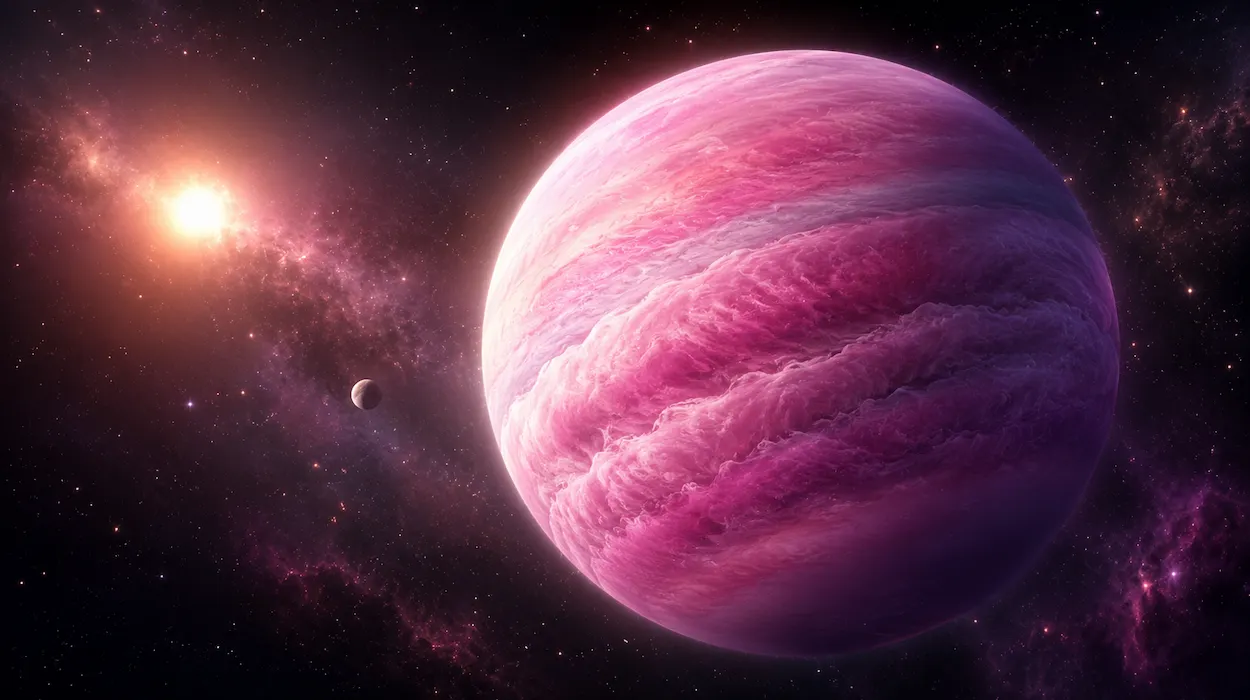
Super puff planets are some of the strangest worlds ever discovered in space. Imagine a planet that is large as Jupiter but so light. If you could somehow place it in a large ocean, it would almost float. It sounds like an imagination story but its truth.
In June 2026, scientists found 2 super puff planets. These large planets have very low density and they are lighter than cotton candy when we compared to their size. This discovery make all scientists very surprised because it is impossible to think that this much large planet have very low density. After the discovery scientists are trying to study, how these planets are formed without collapsing to their own gravity. The findings, published in the Monthly Notices of the Royal Astronomical Society, are giving scientists a rare chance to study one of the biggest mysteries in planetary science.
What Exactly Are Super Puff Planets?
In simple terms super puff planets are giant gas planets with so much low density. Mostly people think large planets have more density and this law is true for many planets like Jupiter as well. But super puff planets break this law. These planets are large as Jupiter but they have only a small fraction of Jupiter’s mass. Hydrogen and helium are the major components of their thick atmosphere. These elements are making super puff planets extremely light.
To understand super puff planets completely, think of a balloon. It is large but very light, because it contains very less material inside it. Similarly, super puff planets are huge in size but their volume is filled with extremely thin gases. Scientists also compare them with cotton candy and marshmallows because they are so “fluffy.” Sometimes their average density is even less than cotton candy. That’s why scientists gave them a nickname “super puff planets”.
Scientists Just Discovered Two New Super Puff Planets

This latest discovery is very interesting because both newly discovered planets orbits the same star. Scientifically name of both planets are TOI-791 b and TOI-791 c. Both planets revolve around a star that is located 1100 light years away from earth.
Scientists discover these two planets by using NASA’s Transiting Exoplanet Survey Satellite (TESS) together with data collected by several ground-based telescopes, including the Antarctic Search for Transiting ExoPlanets (ASTEP) telescope. This discovery has a great importance because finding one super puff planet is already rare but we found two in the same planetary system which is even more unusual. Scientists believe these two giant planets were formed together billions of years ago.
Bigger Than Jupiter, But Much Lighter
This is the most interesting part that totally amazed researchers. Both the newly discovered planets are almost huge as Jupiter. But scientists estimated that both planets are around 35 times lighter than Jupiter. It means that both planets have huge volume but have very little mass inside.
To understand better, you can think two suitcase of equal size. One of them is filled with material of heavy mass like books and another is filled with low mass material like feathers. Suitcase with books is heavier than suitcase with feathers. This difference is similar to Jupiter and both newly discovered super puff planets. Scientists believe that their densities are among the lowest ever measured for any planet.
How Did Scientists Find These Planets?

These planets are not seen directly like planets exist in our own solar system. Scientists used a method called transit method to detect both of them. When a planet passes in front of its star, it blocks a tiny amount of the star’s light. Scientists can measure this small dip in brightness by using sensitive telescopes. By studying these tiny changes again and again, scientists can calculate the planet’s size, orbit, and other important properties. To know about the planet’s mass, scientists also studied how its gravity affects the movement of its parent star. By studying all the collected data scientists calculated the planets’ densities. Results surprised everyone. The planets were much lighter than expected.
Amazing Facts About Super Puff Planets
- Fewer than 40 super puff planets are currently known.
- TOI-791 b and TOI-791 c are among the rare cases where two super puff planets orbit the same star.
- Both planets have densities lower than many everyday materials on Earth.
- Scientists are still debating exactly how these unusual worlds formed.
- In future scientists may solve the mystery of super puff planets by using advance space telescopes.
Conclusion
Universe always surprises us. This new discovery reminds us that universe is still full of mysteries. We can never imagine that planet large as Jupiter lighter than cotton candy. But now scientists found two of them in the same star system. The rarest thing is that both super puff planets are revolving round the same star. This surprised the scientists most. Although researchers still do not fully understand how these strange worlds formed, every new observation brings them one step closer to the answer. As our technology grows, scientists may reveal the mystery behind these planets in future. These giant, lightweight planets prove that space is far stranger and more fascinating than we ever imagined.
Stay connected with Science Scope Hub and keep exploring more mysteries of our universe.
Pingback: NASA Swift Telescope Rescue: The Daring Space Mission That Could Save a Falling Telescope