
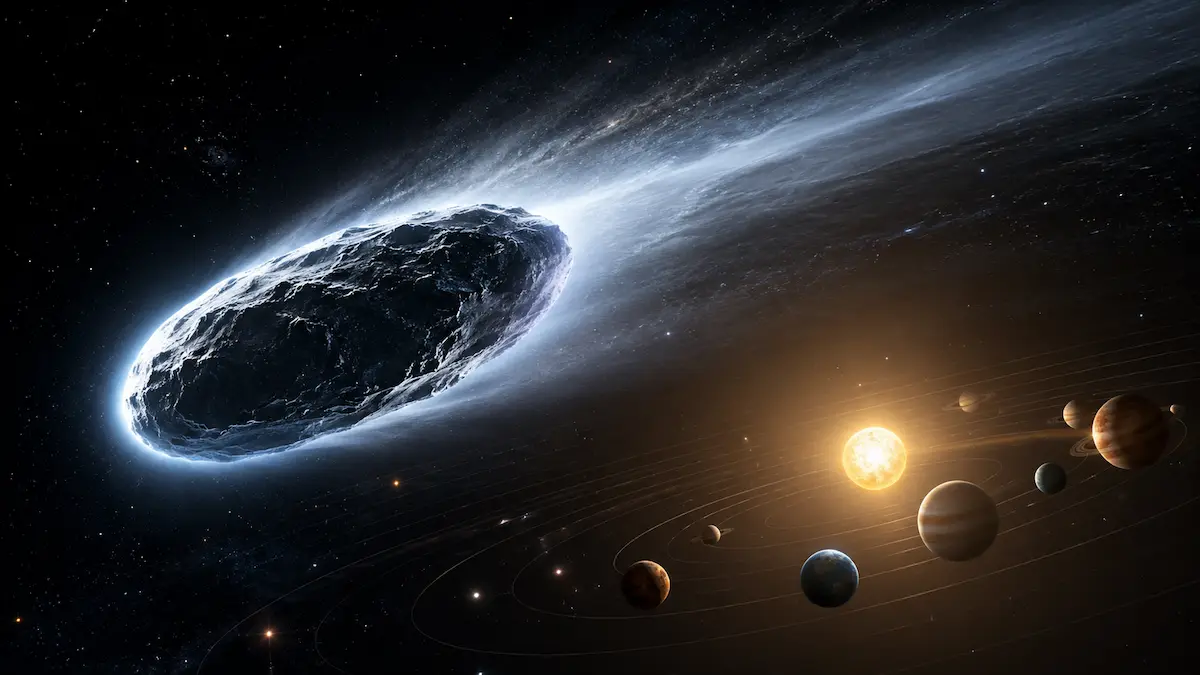
How old is comet 3I/ATLAS? Finally scientists have an incredible answer.
On June 22, 2026 a study published in the journal Nature that estimates comet 3I/ATLAS is between 10 and 12 billion years old. If we compare it with our solar system the Sun, Earth, and all the planets are only about 4.5 billion years old. That means how old is comet 3I/ATLAS is almost beyond imagination. It is more than twice as old as our entire solar system. if we think in another aspect when this comet formed, Earth didn’t exist. The Sun hadn’t formed. Even our solar system had not been created yet. Dinosaurs didn’t exist yet. The atoms that would make our solar system later were still floating in space as cloud of dust and gas.
Today, billions of years later, it entered our solar system. Yet it is like a frozen chunk of ancient ice and rock that consists history of early universe and giving a rare chance to scientists to study early universe materials.
3I/ATLAS releasing water into space.
How Scientists Figured Out How Old Is Comet 3I/ATLAS
You can’t just look at it and know how old is comet 3I/ATLAS by its appearance. So how did scientists actually figure out its actual age?

The chemistry gave us answer. We use James Webb Telescope and it has the ability to read the chemicals inside a space object. As 3I/ATLAS began moving away from the Sun in December 2025, astronomers pointed Webb directly at it. At this time 3I/ATLAS just passed its closest point to the sun. So the sun’s heat melted some of the ancient ice and turns it into a bright gas cloud called coma. That gas cloud is very important because it contains chemicals from the early universe. By studying this cloud with James Webb Telescope, scientists could know about the comet’s chemical compositions.
What Webb found was completely unexpected.
One of the biggest clues to how old is comet 3I/ATLAS came from its water. Scientists found that this comet contained about 30 times more deuterium (also called heavy hydrogen) than water found in comets in our own solar system. This clue is important for temperature. If water contains more deuterium, it means the water forms in extremely cold environment where the warmth from nearby star is very little.
Answering how old is comet 3I/ATLAS also required studying its carbon. James Webb found that the comet contains very less carbon-13, a heavier form of carbon, compared with the more common carbon-12. It matters because the stars produce more carbon-13 as they live or die. They spread carbon-13 in space. Younger star system like our own solar system formed from this recycled matter, so that they contains higher amount of carbon-13. Because 3I/ATLAS has much less carbon-13, scientists believe it formed before many generations of stars had enriched the galaxy with this element.
By studying both clues together, extremely cold and very less carbon-13, scientists reached an exciting conclusion. From this the picture of how old is comet 3I/ATLAS, becomes clear. The comet most likely formed 10 to 12 billion years ago, making it far older than our 4.5-billion-year-old solar system. Martin Cordiner, the lead author of the Nature study and an astrochemist at NASA’s Goddard Space Flight Center described “how old is comet 3I/ATLAS” very simply: “This discovery gave a unique opportunity to study an ancient object from the distant galaxy, probably existed before our Sun and solar system were born.
What Was Happening in the Universe When 3I/ATLAS Formed?

To understand how old is comet 3I/ATLAS, you need to know how universe looked like when it was formed. Around 10 to 12 billion years ago, when comet 3I/ATLAS was formed the universe was very different from today. Scientists called that era “cosmic noon.” That was the most productive ears. Astronomers believe that stars were forming much faster during cosmic noon than any other time in the cosmic history. At that time universe was much smaller, denser and more chaotic. Scientists believe that 3I/ATLAS was formed during this time inside a cold cloud near an unknown and distant star. That star system was much older than our own.
At some time, something powerful pushed the comet out of its star system. But scientists don’t know exactly when or how it was ejected. May be a close encounter with a giant planet pushed it outwards or may be its own star dies and whole star system dissolved in space. No one knows the exact reason. But after leaving its home the comet was launched into interstellar space on a journey with no destination. For billions of years the comet was drifting alone in cold and dark space between the stars. There was no star to provide it warmth and no planet to pull it. It traveled lonely and its freezing temperature helps to preserve its chemicals and early universe history. Then after billions of years, it entered our galaxy Milky Way. In July 2025, astronomers using a telescope in Chile spotted a faint streak of light moving across the sky. And that was comet 3I/ATLAS.
Could 3I/ATLAS Tell Us Something About Life?
The story of how old is comet 3I/ATLAS is not just about its age. It is also about what scientists found inside it.
James Webb Telescope didn’t only found hydrogen and carbon inside it. It also discovers some organic molecules like compounds containing carbon, hydrogen, nitrogen, oxygen, and sulfur. These molecules are the same that are essential for the life on earth. But it does not mean that comet contains life. Instead it means that these molecules can exists in other part of the galaxy, not just in our earth. Stefanie Milam, an astrochemist at NASA Goddard and co-author of the study explained that studying objects like 3I/ATLAS help us to know whether these organic molecules essential for life are common in universe or rare.
Milam means that 3I/ATLAS was came from another star system and formed in early universe before our sun existed. And still it contains organic molecules necessary for life. It does not mean that comet contains life. There is no such evidence. It only suggests that the chemistry needed for life isn’t unique to our solar system. It appears to be scattered across the universe. That is why learning how old is comet 3I/ATLAS is about much more than its age. It give us new clues about life in the universe.
A Few More Surprising Facts About Comet 3I/ATLAS
While studying how old is comet 3I/ATLAS, there are a few other remarkable details worth knowing:
It’s the oldest object ever observed in our solar system: Martin Cordiner himself described 3I/ATLAS as probably “the oldest object ever observed passing through our solar system.” Everything we study asteroids, planets, stars, comets, moons formed about 4.5 billion years ago with our solar system. But scientists estimated that 3I/ATLAS was formed about 10 to 12 billion years ago.
It formed in a colder, lonelier part of the galaxy: evidence suggested that it was formed on a colder and isolated region of the Milky Way galaxy and that region was chemically rich than where our sun was formed.
It’s already leaving: It passed its closest point to the Sun in October 2025 and is now heading back out into interstellar space. Now it will never return to our solar system. So that scientists are studying it as quickly as possible before it disappears forever.
It was found by chance: it is the most interesting fact, scientists were not searching for an interstellar object but it simply showed up. The NASA funded ATLAS telescope in Chile and it was mainly looking for asteroids that could pose a threat to Earth. In July 2025, it detected a faint object moving across the sky, and that was 3I/ATLAS.
Conclusion
So, how old is comet 3I/ATLAS?
It is old enough to make our 4.5-billion-year-old solar system look like a newcomer. Scientists estimated that 3I/ATLAS was formed about 10 to 12 billion years ago. Its age is more than twice than our won solar system. It was formed when the material that made the earth, oceans and everything that we see today, was drifting in space. At some time it starts its journey and entered our solar system. As it passed close to the Sun, the heat released ancient gases that had been trapped inside the comet since its formation. Using James Webb scientists got a chance to look the chemicals traps inside it. This helps us to know better about the early universe and how common the ingredients of life spread across the universe. Today, 3I/ATLAS is already leaving our solar system and will continue its journey through interstellar space. It is unlikely to ever return. But the answer to how old is comet 3I/ATLAS will stay with science forever and the data it left behind will keep scientists busy for years. Stay connected with Science Scope Hub for more amazing space discoveries.
Pingback: Super Puff Planets: Scientists Just Discovered 2 Giant Worlds Lighter Than Cotton Candy