
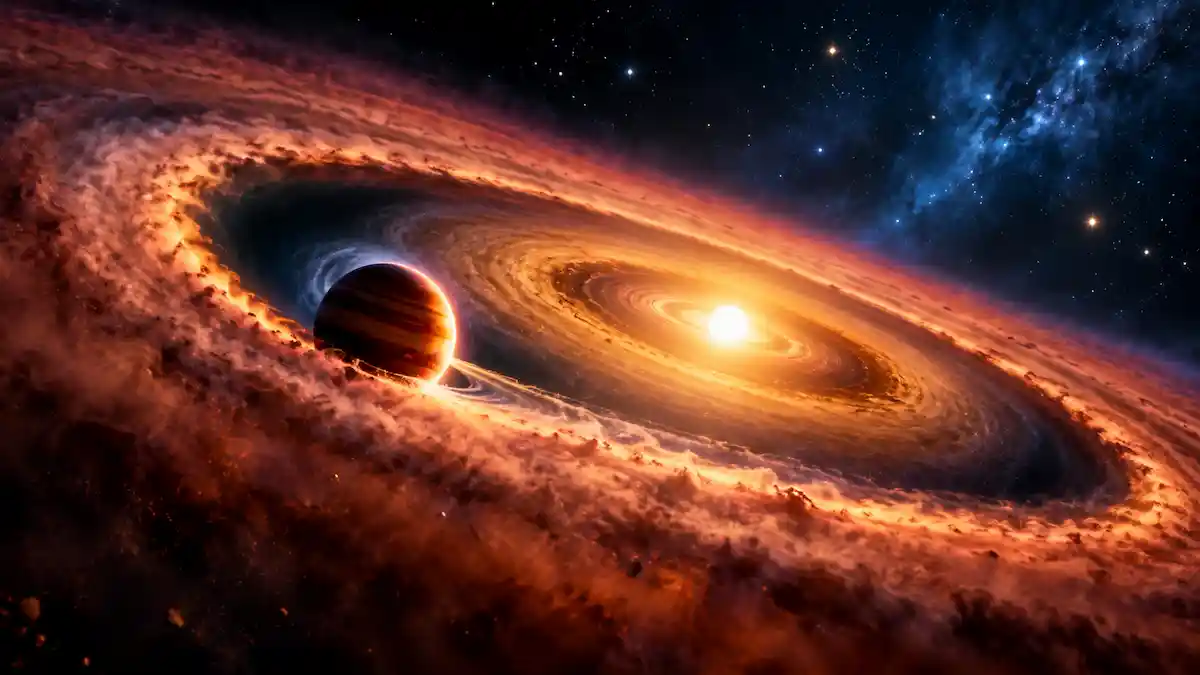
Astronomers have just discovered something absolutely remarkable. A planet that formed less than one million years ago is now the youngest known planet ever identified. It is named as, Elias 2-24 b, this planetary newcomer retains a ring of gas and cosmic dust from which it formed. Even more remarkable, this planet is about the same mass as Jupiter and orbits its star at an average distance of 55 times greater than the distance between Earth and the Sun.
The discovery can provide valuable information to scientists about the planet formation. This planet has quickly come together, so it raises a question; how did this Jupiter size gas giant form so quickly and so far away from its star? The youngest known planet is not just another entry in an exoplanet catalog. It is a test of astronomers’ understanding on how these huge planets are born.
Roman Telescope Could Last 22 Years After NASA Saves Huge Amount of Fuel
What Makes Elias 2-24 b the Youngest Known Planet?
Elias 2-24 b, youngest known planet revolves around a young star which is know as Elias 2-24, and it is about 450 light-years away from the Earth. This young star has a protoplanetary disk of gas, dust, and rocky debris around it. The planet is most likely formed within these disks. During the formation, pebbles, and boulders of various sizes collided and stuck together, forming planetesimals. These are then pulled together by the gravity of larger bodies, eventually forming planets. For a gas giant to form like Jupiter, there must be enough gas for it to accumulate and form around a young star.

The youngest known planet is remarkable because it has already grown to Jupiter’s mass while still young. NASA explains that the planet is less than a million years old, this is remarkable because most of the known planets have been discovered to be older and far beyond their formation period. There were previously four planets that held the record for youngest known planets. Two orbiting PDS 70 and other two orbiting WISPIT 2. These planets were discovered to be more than five million years old, but Elias 2-24 b is much younger than those planets, beating their records. However, age is not the only amazing thing about the youngest planet. The planet is also strangely far from its star.
Why Is This Baby Planet So Difficult to Explain?
Elias 2-24 b is 55 times farther from its star in comparison to Earth’s distance from the Sun. This is an impossibly wide distance, even surpassing Jupiter’s orbit around our sun. According to the current planet formation models the researchers described, a Jupiter-size planet would take five million years to form at Jupiter’s distance, and even longer beyond. This creates a problem; the researchers have found a Jupiter mass planet, which should take far longer time to form than their estimated age of less than one million years, and the planet sits very far from its star. The youngest known planet appears to have formed much faster than expected.
Scientists aren’t surprised, but this finding might hint that some part of the process of forming giant planets is missing or poorly understood. One part of the formation process that might be missing is the way material moves and gathers inside a young planetary disk. The disk isn’t a smooth and quiet ring of material, but a dynamic mixture of clumps, gaps, streams of material flowing in all directions, and a complex interplay between gas, dust, and forming planets. The youngest planet discovered might be an example of a process that have not yet captured completely.
How Did Scientists Confirm the Youngest Known Planet?
The story of Elias 2-24 b actually began a decade ago. Astronomers saw something strange while observing this young, forming star with ALMA, one of our powerful telescopes. It revealed a prominent gap in the dusty disk around Elias 2-24. Then, European Southern Observatory’s very Large Telescope spotted a tiny speck of light inside the gap. Many astronomers immediately thought it was a planet, but they simply did not have enough information to prove. The planet was just too far away from the star, and the star was just too young, making such a planet quite difficult to find.

Andrea Bernardi and his his team started digging through old data from the W. M. Keck Observatory in Hawaii. They eventually found the same faint light in images taken in 2018 and 2020. By analyzing these images, the astronomers could study how the planets move over time. Its motion matched the prediction for a planet orbiting Elias 2-4 star, rather than a speck in the telescope’s optics or a distant background star. With this information, the astronomers finally proved that Elias 2-24 b was the youngest known planet in existence.
This is an important discovery to astronomers because direct imaging of a young planet is really difficult and hard with our current technology. They are so much dimmer than the stars they orbit, and also very close to them. On top of that, the planet may be hidden behind the dense, dusty nebula where it formed. The coronagraph on the Keck however proved to be an amazing tool. It was able to block the intense glare of the star, revealing other faint objects as well. This allowed us to see the youngest known planet, hidden inside a dusty nebula, inside a gap in the star’s debris disk.
Why This Young Planet Matters for Planet Formation?
Most of the exoplanets that humanity has detected are not baby planets. Astronomers have used a method called the transit method to detect most of them. This method is not efficient if a planet is hidden by the dense dust of its swirling planetary system, or has a wide orbit. This has created a problem for astronomers, since the galaxy is constantly producing new stars and planets, but they are nearly impossible to see. That’s why newly youngest known planet is so valuable to NASA. It is rare and provides insight on how planets form. NASA stated that most of the roughly 6,000 confirmed exoplanets are billions of years old and orbit close to their stars.
The astronomers hope to use this planet to gain insight on the accretion processes of giant planets. It could provide information on how quickly a planet grows to full size, the orbital dynamics of planetary systems and perhaps most importantly, compare the young Elias 2-24 system to the early history of our own Solar System. The planet is even more valuable because it is still partially enveloped by the chaotic dust and gas of its formation, researchers are excited. Instead of examining ancient planets, they can study a young star system with planets that are still forming.
Conclusion
The youngest known planet provides a unique insight on a world in formation. The Jupiter-mass planet, called Elias 2-24 b, is less than 1 million years old and still surrounded by the gas and dust from which it was formed. Unlike many of the exoplanets previously discovered, this one has not completed its formation process yet, it’s still forming. And that’s actually important information to astronomers who are seeking to understand how planets form.
Elias 2-24 b is at incredible distance from its star. This youngest known planet is 55 times farther from its star in comparison to Earth’s distance from the Sun. This is an impossibly wide distance, even surpassing Jupiter’s orbit around our sun. The youngest known planet goes beyond giving us an amazing insight on the creation of worlds. With more discoveries of planets similar to Elias 2-24 b, scientists would be able to increase their understanding of how these young planets form and exist in such conditions long enough for them to become visible to us. With more planets to study, we can better understand exactly what makes planets come to be. Future NASA facilities such as the Nancy Grace Roman Space Telescope will play a role in finding these young worlds and helping astronomers understand them.