
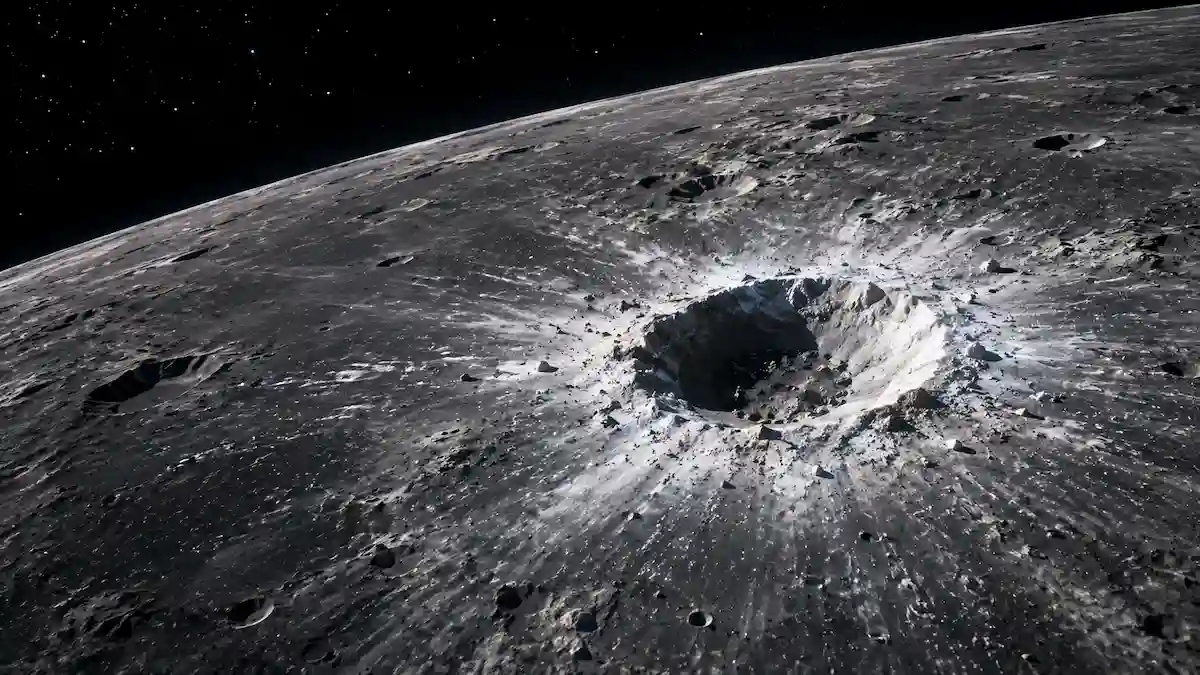
Scientists just found a new crater on the Moon. Lunar Reconnaissance Orbiter (LRO) of NASA detected this new impact site and scientists are comparing images of the lunar surface capturing at different times. Scientists called this new crater on the Moon, McGetchin crater. It is about 222 meters (728 feet) wide and 43 meters (141 feet) deep. Scientists study it deeply and stated that it was formed in between April 11 and May 22, 2024. It happened when a space rock, probably originated from asteroid or comet landed on the Moon surface. An impact capable of forming such a large crater is only happen about once in a century or even less frequently.
Roman Telescope Could Last 22 Years After NASA Saves Huge Amount of Fuel
What makes the discovery important is not only the size of the crater, but the fact that astronomers were able to calculate when it was formed. Scientists make this possible because the LRO has photographed the same place before the impact, giving the scientists a side by side view of what happened on the Moon. This kind of evidence helps them to better understand such phenomena in which a space rock affects the lunar surface.
Why This New Crater on the Moon Is So Important?
Moon is look very calm from far but it’s surface is exposed to most of the space threats. Moon does not have a thick layer of atmosphere is which most space rocks get burn. And it also don’t have rain, rivers, forest and tectonic plates that help in erasing the space rock marks on the impact site. So the lunar craters are kept for a very long time, serving as an historical repository of impacts that have been occurring in the solar system. The new crater on the moon is different from the rest of moon’s older craters in terms of age. It is young enough for researchers to compare the captured images before and after its formation.
That makes McGetchin crater a natural experiment. Researchers can study how far material was thrown off the crater, how the ground around the crater was disturbed, and how the freshly exposed regolith changes over time. This is all valuable information that might allow scientists to make conclusions about what happened shortly after an impact occurred instead guessing what happened hundreds of millions of years ago.
This new crater on the Moon is also the largest discovered one during the lifetime of NASA’s Lunar Reconnaissance Orbiter. NASA satellite has been observing the moon since 2009. It has taken many pictures in those years. Scientists detected this new crater on the Moon by comparing older images with newer observations. The crater was named after Tom McGetchin, an honor to a lunar scientist. The crater is about 222 meters long, which is equivalent to twice the length of an American football field, making it surprising that such a crater could be formed on just a small portion of the moon.
How NASA Found the New Crater?

The new crater on the moon did not come when scientists were specifically looking for this crater. In October 2025, a image analyst name, Robert Wagner was performing a routine checking of images from Lunar Reconnaissance Orbiter. He spotted an unusual bright spot surrounded by a dark halo on the lunar surface map. It immediately attracted the team and they said that if there were a recent impact, there would be a mark like this. Freshly exposed rocks and debris around the hole caused the anomaly in the image, so Robert went back and started cross-referencing later LRO images with older images. This comparison led to the important discovery, that the mark wasn’t there before. After that Lunar Reconnaissance Orbiter Camera team was able to find that this mark was made between April 11 and May 22, 2024, during a period when the LRO was circling the moon. The before and after images comparison evidence proved that it was a fresh impact, and not just a crater that had gone unnoticed.
That is advantage of taking photographs of lunar surface over a long period of time. One single photo of new crater on the moon would show scientists that how lunar surface looks today, but it wouldn’t give nay evidence of when this new crater on the moon formed. Previous photos taken by the LRO act as a historical record of the same spot on the moon.
What Created This New Crater on the Moon?
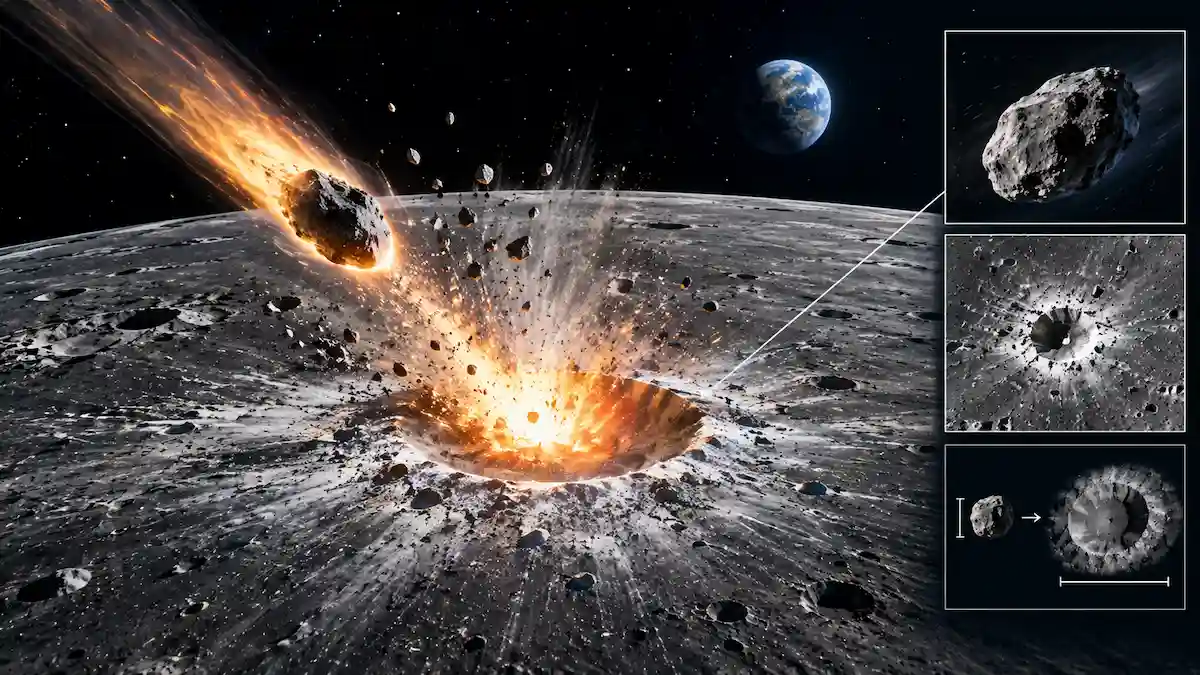
Scientists think a comet or asteroid fragment came down and struck the lunar surface at very high speed, creating the new crater on the Moon. The estimated size of the impactor is about the length of a three- to six-story building. It was much smaller than the 222-meter-wide crater it created. But it strikes the moon at incredibly high speed and create a huge crater. When this type of object hits the moon, things happen in an extremely short time. The object and some of the material where it hits are shattered by the great force of the impact. Rock and debris are thrown off in all directions, forming a crater and a huge area of ejected material around the impact site. This area of ejecta is significant because it provides clues to the direction and power of the impact.
The new crater on the Moon also has a much bigger thermal signature than the crater itself. NASA found a cold region around the McGetchin crater, which extends about 4 miles (6.4 kilometers). At night this region’s temperature reach about 16 degrees Fahrenheit (8.8 degrees Celsius) which is cooler than the surrounding area. It happens because of the lunar soil, known as regolith. The impact messed up the regolith around the crater, creating the ejecta. The regolith normally includes fine grains of rock and compacted material, and this affects how the ground stores and releases heat. When an impact messes up that particular pattern, the thermal pattern is also affected. NASA’s Lunar Reconnaissance Orbiter has a diviner that measures infrared light and help scientists to analyse the thermal properties of the Moon’s surface. Its findings help scientists to detect this broad region of cold around the new crater on the Moon.
Conclusion
The discovery of this new crater on the Moon, reminds us that the lunar surface is still changing. McGetchin crater was created only around two years before NASA announced its discovery. The 222-meter width, unusual thermal signature, and well-documented formation period give scientists an unusually detailed case study of a major lunar impact.
Most lunar craters are ancient scars left from a much more violent period in the early solar system. McGetchin is different because researchers have images showing the area before the collision and after the collision. This makes the new crater on the Moon, more than just another hole in the lunar surface. NASA’s Lunar Reconnaissance Orbiter spacecraft continues to map the Moon, it will uncover more recent impacts, and each finding will contribute a vital piece of information to understand our universe.
YOU MAY LIKE
- Radio Signal From Exoplanet Detected for the First Time, and It’s Not Aliens
 A radio signal from exoplanet Beta Pictoris b has just been confirmed by astronomers. This is the first time when scientists have directly traced radio waves to a single planet outside our solar system rather than to its host star. Before you get too excited about first contact, here’s the twist: this radio signal from… Read more: Radio Signal From Exoplanet Detected for the First Time, and It’s Not Aliens
- NASA Starliner Update: Boeing’s Troubled Spacecraft Won’t Fly Astronauts Until 2028
 NASA Starliner Update just came out, and it answers a question many people have been asking since 2024; when will this spacecraft carry astronauts again? On Monday, September 28, NASA and Boeing held a press conference at Kennedy Space Center to share a new plan for the Starliner program. Here is the short version: an… Read more: NASA Starliner Update: Boeing’s Troubled Spacecraft Won’t Fly Astronauts Until 2028
- Starship Flight 14 Result: Reaches Orbit, Deploys 26 Starlink Satellites, Ends Early
 The Starship Flight 14 result is a success with one major catch. SoaceX’s Starship is the largest and most powerful rocket in the world. And it reached the Earth’s orbit for the first time on Monday, September 28. It lifted off from Starbase, Texas, at 7:48 a.m. CT (8:48 a.m.EDT). This mission delivered 26 upgraded… Read more: Starship Flight 14 Result: Reaches Orbit, Deploys 26 Starlink Satellites, Ends Early
- Swift Telescope Rescue Mission Failed: What Happens to NASA’s 22-Year-Old Observatory Now
 The Swift Telescope Rescue Mission has failed, and scientists expect that NASA’s Neil Gehrels Swift Observatory fall back to earth and burn in the atmosphere by early November. A company name, Katalyst Space Technologies was handling the rescue mission, which cost about $30 million. In the mission, they planned to use a robotic spacecraft name… Read more: Swift Telescope Rescue Mission Failed: What Happens to NASA’s 22-Year-Old Observatory Now
- James Webb Just Found the Smallest Brown Dwarfs Yet — And They’re Challenging How Stars Are Born
 NASA’s James Webb just found the smallest brown dwarfs ever discovered. JWST spotted a group of brown dwarfs in the young star-forming region IC 348. Scientists estimate these objects are so light that their mass is only about twice the mass of Jupiter. These objects are too small to become normal stars, but they may… Read more: James Webb Just Found the Smallest Brown Dwarfs Yet — And They’re Challenging How Stars Are Born
- SpaceX Starship Flight 14: World’s Biggest Rocket Attempts First-Ever Orbital Launch
 SpaceX Starship Flight 14 is almost ready to make history this week. This mission is different from every test that Starship has attempted before. Previous 13 flights were designed as suborbital tests, but Flight 14 is planned to take Starship into Earth orbit for the first time. If everything goes well in the mission, it… Read more: SpaceX Starship Flight 14: World’s Biggest Rocket Attempts First-Ever Orbital Launch
- Highest Temperature Life Can Survive: NASA-Funded Research Just Broke a Heat Record
 NASA funded a mission to see for highest temperature life can survive. It results a newly discovered tiny organism which lives in the hot springs of California and it has the ability to survive on surprising temperature 63°C (145°F). This organism is a newly described amoeba called Incendiamoeba cascadensis, nicknamed the “fire amoeba.” Researchers found… Read more: Highest Temperature Life Can Survive: NASA-Funded Research Just Broke a Heat Record