
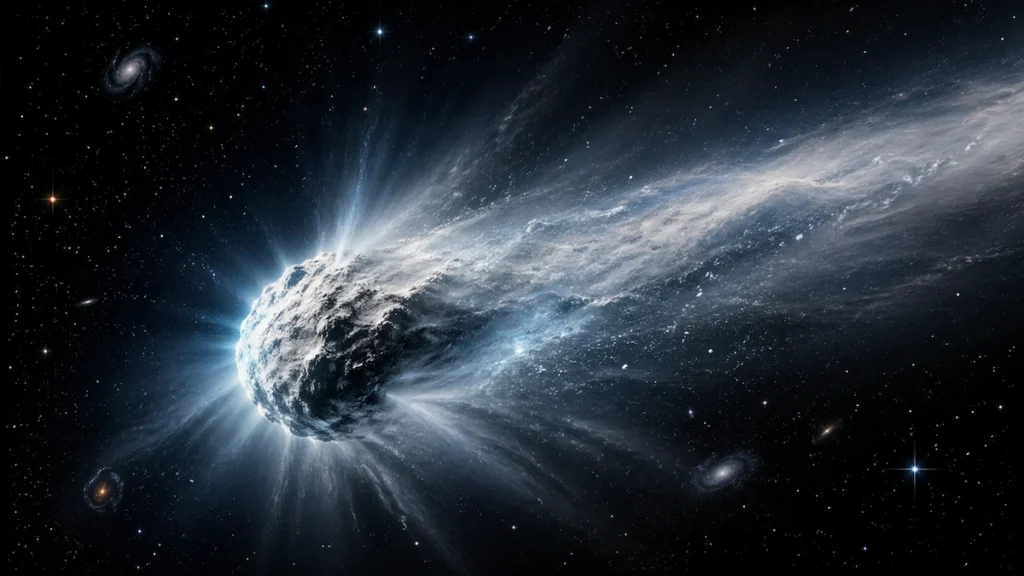
3I/ATLAS releasing water into space has become a major topic in the space world. New objects are discovered regularly, but only a few create this level of interest. Researchers noticed that this object may be active, meaning it could be giving off gas and dust as it travels. That is why so many observatories are now studying it closely. Early data suggests 3I/ATLAS releasing water into space may be much more important than it first appeared.
The real excitement comes from what scientists might learn from it. Objects like this can preserve ancient ice and dust for extremely long periods of time. By examining those materials, researchers may better understand how distant star systems form comets and other frozen bodies. Some of the matter surrounding 3I/ATLAS may have existed long before Earth formed. That possibility has made this mysterious traveler one of the most discussed discoveries of the moment.
What Is 3I/ATLAS and Why Is It So Important?

When I first read about 3I/ATLAS, it immediately stood out from the usual space headlines. We hear about asteroids and comets all the time, but some objects feel different from the start. This is one of them. 3I ATLAS was discovered by ATLAS sky survey team on July 1, 2025. It is an interstellar comet that means it does not belongs from our solar system. It is coming from another star system carrying many secrets. It immediately caught scientist’s attention because it appears to be active, which means it may be releasing gas and dust as it moves. That’s why 3I/ATLAS releasing water into space has become such a fascinating topic.
What makes this comet interesting to me is the idea that an object like this can carry ancient materials that has stayed frozen for ages. Imagine something traveling silently through the space for an extremely long time and now it begins to reveal what is inside. If researchers confirm 3I/ATLAS releasing water into space, it means that when the sunlight interacts with the hidden ice of the comet, it escapes in the form of water.
This is a great chance for scientists to study about the universe because objects like this can preserve clues from the past. They may contain dust, ice, and gases from the early stages of planetary systems. In a way, 3I/ATLAS releasing water into space is not just another discovery—it may be telling a story that began long before Earth existed.
Why Scientists Think 3I/Atlas Is Releasing Water Into Space
When scientists say 3I/ATLAS releasing water into space, they are not guessing. They base this idea on how active icy objects behave when they move closer to the Sun. As the frozen ice comes in the contact of sunlight, it can change directly into gas. This process is called sublimation, and it is common in many known comets. Scientists constantly studying about the 3I/ATLAS and they notice some signs that suggest this kind of activity may be happening. Advanced Telescopes can detect a cloud of gas and dust around the comet, often called a coma, or notice a faint tail forming behind it. These signs are usually appears when the ices beneath the surface start to heat up. That’s why scientists believe 3I/ATLAS releasing water into space.
Scientists also use a method called spectroscopy, to study the light from distant objects. Different gases leave unique patterns in light; it allows researchers to detect what may be present. By using this technique, they can collect evidence related to water vapor and other molecules. This helps to support the idea of 3I/ATLAS releasing water into space. More observations are required, but current evidence follows patterns often observed in active comets. That’s why scientists continue tracking the comet closely and studying whether 3I/ATLAS releasing water into space can be confirmed with stronger data.
What if earth stopped spinning for 5 seconds?
How 3I/Atlas Releases Water Into Space
When people hear about 3I/ATLAS releasing water into space, it does not mean streams of liquid water are flowing from the comet. In the cold environment of space, water is usually locked inside the comets and icy bodies as frozen ice. When 3I/ATLAS moves closer to the Sun, sunlight interacts with the ice and it begins to warm. As a result, ice changes directly into gas. This natural process is known as sublimation. Once this happens, the gas escapes through cracks or loose areas on the surface. As it goes outward, it can carry tiny dust particles with it. This often creates a thin cloud around the object called a coma, and sometimes a tail that points away from the Sun. These are the visible evidence and reasons why scientists believe 3I/ATLAS releasing water into space is likely taking place.
How Scientists Detect Water From Millions Of Miles Away
Many people thinks, how scientists found 3I/ATLAS releasing water into space when the object is so far away in space. The answer lies in one of the most important scientific tool known as spectroscopy and advanced telescopes. This method helps astronomers to study light from distant objects and identify the substances linked to that light. Each gas leaves its own pattern when it interacts with light. Scientists know how to measure the water vapor recognizable signals. By checking those signals carefully, scientists can find the evidence that is connected to 3I/ATLAS releasing water into space. In simple terms, they are using light to read the comet’s chemical composition even from a great distance in deep space.
Scientists also watch carefully the size of the object over time. If 3I/ATLAS begins to show a hazy cloud around it or a thin tail behind it, then it means frozen material is getting heated up and turning into gas. These changes are common in active icy bodies moving closer to the Sun. That’s why many scientists continue studying 3I/ATLAS releasing water into space with great interest. Earth’s scientists collect data with the help of telescopes continuously. By comparing images and light patterns over many nights, astronomers build a clearer picture of what is happening in space.
What Makes 3I/ATLAS Different From a Normal Comet?
At first glance, 3I/ATLAS may look like an ordinary comet, but scientists are interested on it, because it may not have formed in our solar system. Most known comets were formed inside our own solar system and remain linked to the Sun’s gravity. They usually come from icy regions far beyond Neptune and return on long orbital paths. Most of them originated from regions such as the Kuiper Belt or the distant Oort cloud, both are the part of our own cosmic neighborhood. If the current studies are correct, 3I/ATLAS releasing water into space while following an interstellar path, it would make this comet very different from the comets we usually observe.
The biggest difference could be its origin. A normal comet is made of materials that are formed around our Sun billions of years ago. But if 3I/ATLAS came from another star system, then the ice, dust, and rock inside it may have formed under completely different conditions. This is one of the reasons, why 3I/ATLAS has gained so much scientific attention. Scientists are also studying about its speed and orbit. Any normal comet follows path controlled by the Sun’s gravity and often return after long periods. An interstellar object moves on a path that passes through once and then never returns. They are like travelling in one way journey. So it would be a rare chance to study material from beyond our solar system.
What 3I/Atlas Could Reveal About Other Worlds
Currently Scientists are studying about 3I/ATLAS releasing water into space and what can we learn about another star system from it. Objects made of ice and dust often preserves old material from the time they formed. If 3I/ATLAS truly came from another star system, it may carry information about the environment of its parent star. This makes 3I/ATLAS more valuable for learning about distant worlds, where we cannot travel directly.
By studying the gases and particles around it, scientists can compare its chemical properties with the comets found in our own solar system. If the materials look similar, it may suggest that other star systems have mostly the same material like our own. If the composition is different, it could show that planets and comets form under many different conditions. This is one of the reasons why this topic “3I/ATLAS releasing water into space” has attracted so much scientific attention.
Conclusion
In the end, the story of 3I/ATLAS releasing water into space has gained so much global attention because it may be much more than an ordinary comet. Early observations suggest this comet does not belong to our solar system and possibly come from a distant another star system. It could contain ice, dust, and gases that have remained preserved for a very long time. If that is true, then it is a golden opportunity for scientists to study material that formed far from Earth and possibly even far beyond from our solar system. The hidden information inside it makes this discovery even more valuable. Frozen bodies can act like a natural storage capsules that contains ancient materials. Every bit of gas, dust, and ice linked to 3I ATLAS may hold clues from a distant past. That turns one passing visitor into a messenger from another part of the galaxy.
Pingback: Golden Orb Found In Alaska Ocean Leaves Scientists With One Big Question
Pingback: Spacex Falcon Heavy Launch Delayed As Rocket Prepares To Carry Viasat-3 Satellite
Pingback: How Old Is Comet 3I/ATLAS? James Webb Just Revealed It's Nearly 3 Times Older Than Our Solar System