
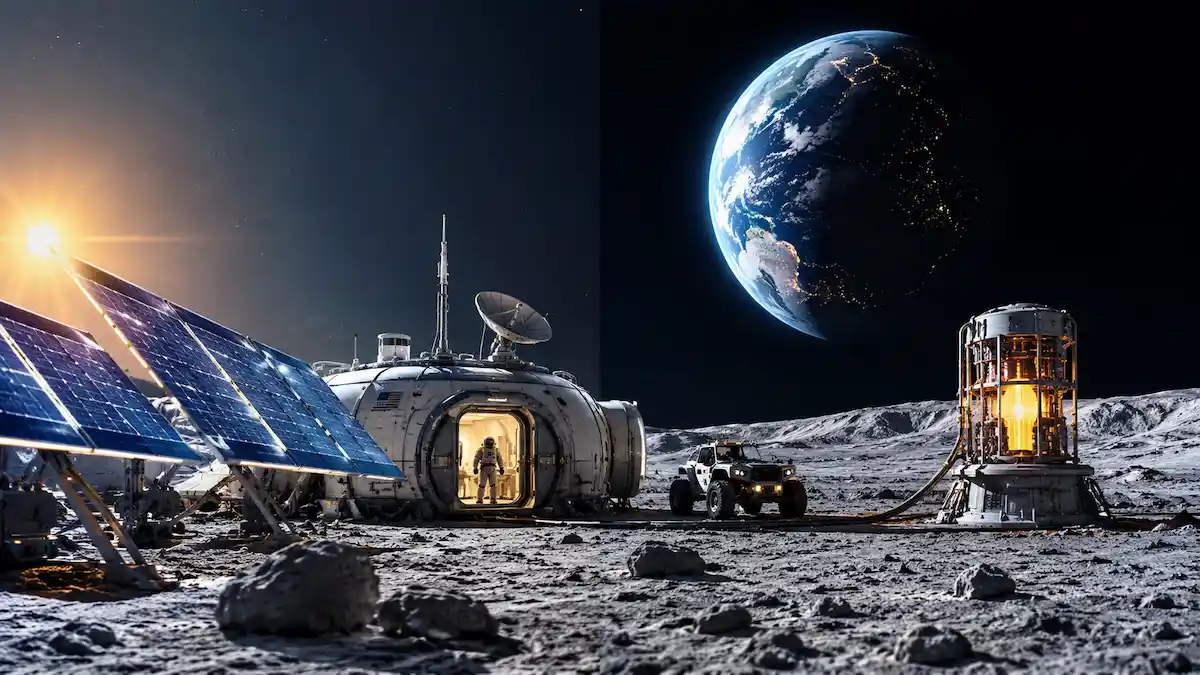
Imagine that you were wale up inside a NASA Moon base and look out a window. The sun is gone, or at least, it hasn’t appeared for about two weeks. This is a serious problem for a future NASA Moon base’s survival. Electricity is required to power life support systems, heaters, computers, communications gear, scientific findings, robotic vehicles, and much more. Solar power would seem like a good choice, but what if the moon enters a period of darkness? The thing is, that NASA isn’t planning to depend on a singular power source to fuel their operations in the future. NASA’s future plans can utilize Solar energy, backup power, and even nuclear fission to power NASA moon base in the case of long periods of darkness. Here’s how we could do it.
Why Does the Moon Have About 14 Days of Darkness?
The Moon does not have day and night like in our Earth. There’s a lunar solar day that lasts for about 29.5 Earth days. On that day, half of the time will be “day” and the rest will be “night”. That means some places in the moon can have about 14 earth days of sunlight, and 14 earth days of darkness.
That can be a problem for NASA if they are planning on making a lunar base. On earth solar panels can’t generate electricity at night, but we also have other things like power plants and batteries to power the cities that the solar panels can’t reach to. The NASA moon base wouldn’t have any power grid nearby to tap into. To make it even harder the temperature at night on the moon can get extremely cold, so they might need to heat up some equipment just to keep them from freezing. This is why the temperature near the South pole of the moon is such a concern to NASA.
Solar Panels Could Provide Much of the Power

A simple source of energy on the Moon is the sun, that we use every day in space. Solar panels collect the sun’s energy by converting light into electricity. Solar panels don’t need fuel delivered from earth to produce electricity. Solar panels would be a great resource for the NASA Moon Base for many reasons. They can provide electricity for the habitat, the research, the communications, and even more. The electricity would have to be stored for the period when the sun isn’t out.
There is one problem though. When the sun goes down behind the moon, solar panels on the surface can’t produce electricity. Therefore, the solar panels are rendered useless until the next time the sun peaks out. A research facility on the surface of the moon would need to have enough stored power to last them until the sun rise again. This would require a large amount of electricity to be stored.
YOU MAY LIKE
- New Tesla Roadster Takes Flight — But Elon Musk’s Original Car Is Still in Space
 This week, Tesla Roadster comes twice in the news for two very different reasons. On October 15, 2026, Tesla showed off a new Roadster prototype in Texas that appeared to lift off the ground using thruster technology inspired by SpaceX. While the new Roadster was making headlines on Earth, the original red Tesla Roadster that… Read more: New Tesla Roadster Takes Flight — But Elon Musk’s Original Car Is Still in Space
 - Astronomers Find the First Green Star – Could Our Sun Also Glows Green After it Dies?
 Astronomers just found the first green star and the reason of its unusual color is surprising. Astronomers at the University of Warwick have detected a dead star that actually looks green to the human eye, something that never confirmed before research. Scientists believe that the star has gained this green color because it consumes some… Read more: Astronomers Find the First Green Star – Could Our Sun Also Glows Green After it Dies?
 - Microblazar Discovered In Our Galaxy, After 30 Years of Searching And Its Jet Is Pointed Straight At Earth
 Recently a microblazar has been confirmed in our own galaxy, Milky Way. Scientists have been investing this cosmic mystery for nearly 30 years. The study reveals that the object named IRAS 18293-0941 sits about 1200 light years away from Earth and one of its powerful jets points straight towards the Earth. It sounds danger but… Read more: Microblazar Discovered In Our Galaxy, After 30 Years of Searching And Its Jet Is Pointed Straight At Earth
 - Orionid Meteor Shower: The Ancient Shooting Stars That Left By Halley’s Comet Centuries Before You Were Born
 The Orionid Meteor Shower returns this month, and brings beautiful streaks of lights and fill the dark sky with colours. Each meteor burning up in the sky is a tiny piece of dust that left behind by the Halley’s Comet hundreds of years ago. Now centuries past, and when Earth passes through this old trail… Read more: Orionid Meteor Shower: The Ancient Shooting Stars That Left By Halley’s Comet Centuries Before You Were Born
 - Northern Lights Alert: Aurora May Be Visible in 22 US States Tonight
 Northern Lights Alert is going out across parts of the United States tonight, and if you live in the right state, you might get a rare chance to see the aurora borealis without booking a flight to Alaska or Iceland. NOAA’s Space Weather Prediction Center has issued a geomagnetic storm watch for the night of… Read more: Northern Lights Alert: Aurora May Be Visible in 22 US States Tonight
Could Batteries Keep a NASA Moon Base Alive?
Batteries could supply power to a NASA Moon Base, but they might unable to give enough energy to power an entire lunar colony. Basically how it works is solar panels produce electricity for the NASA moon base while batteries store some of the electricity for after dark, once the sun goes down the electricity stored in the batteries can power things to keep the base functioning.
The problem is the length of the lunar night. On some places of the moon darkness can lasts about 2 earth weeks. Which means astronauts will need backup power to run life support, heating, communications, computers, and scientific equipment, even store lighting systems. Another challenge is the cold temperature at night. Batteries would have to be insulated from the cold, which reaches about -180 degrees Celsius. This means that batteries are likely to be used along with other power sources as a backup, provide power during peak times, and to store extra power. Which means a power source that can last through the long lunar nights might be needed.
Nuclear Power Could Solve the Lunar Night Problem

Nuclear power could supply the electricity that solar panels cannot. NASA is working on fission surface power supplies that could produce electricity on the NASA moon base during the day and the long nights. A reactor produces electricity when nuclear fission occurs in it. So the electricity will produce whether the sun goes below the moon’s horizon. NASA and the U.S. Department of Energy have studied a 40-kilowatt-class fission surface power system for possible use on the lunar base. Scientists believe that, this power system could provide enough power for NASA moon base. This power could run many things including habitats, vehicles, scientific instruments, and other equipments.
Nuclear power would have more benefit for a NASA moon base because it is located further away from the Earth’s reach. However, a reactor would still have to be designed with special caution in order to handle the power production, heat, radiation, transportation, and more. The best approach to solving the problem would be combining solar power with batteries, and then also nuclear power. The solar panels can produce the electricity during the day, batteries can store electricity for times of need, and nuclear power plants can produce more electricity when the solar panels cannot and when the batteries alone are not enough.
The Future Power System May Use More Than One Source
The smartest solution for a NASA Moon Base might not be a matter of solar versus nuclear. The best plan is to use them both. Solar panels could collect electricity and store it in batteries when the Sun is out, and a nuclear reactor could provide backup power when sunlight is unavailable. Batteries could then supply power to meet increases in demand or provide additional backup power. The plan would provide multiple layers of backup power. If solar panels fail to produce enough electricity, then nuclear reactor can take over and fulfill the need. If a facility needs even more electricity, then batteries can provide additional power. And if a particular system goes down, another can be substituted. Such a system would be especially valuable to astronauts who are hundreds of thousands of miles away from home.
How Much Electricity Could a Lunar Reactor Produce?
NASA’s previous work on Fission Surface Power was focused on a system that would generate around 40 kilowatts of power while still keeping the weight under six metric tons for the mentioned project. NASA claimed that the output of such a reactor would be enough to facilitate a test system while also providing the necessary electricity for lunar habitats, vehicles, redundant systems, or experiments. However, it would be wrong to claim that NASA moon base will need exactly one 40-kilowatt reactor in future. NASA’s requirements and designs can change along with the progress of lunar colonization.
In fact, NASA has studies based on higher power requirements. According to a report by NASA in 2025, they have begun work on a system that would be able to provide at least 100-kilowatts of electricity by the fiscal year 2030. It shows a possible increase in the requirement of power for the NASA moon base in future. However, the reason for this increase is simple: The bigger the settlement, the more electricity it will need.
Why the Lunar South Pole Is So Important?
The moon’s South Pole is one of the areas that we would most like to explore in the future due to solar power, shadows, and ice. At the poles, sun remains close to the horizon, meaning the southern slope faces the sun almost directly and can gain more energy. But other areas around the pole are completely shaded from the sun by large cliffs. These shadowed regions of the pole are actually quite cold. The temperatures there are cold enough to make ice. This ice could be very useful to the astronauts because it could provide life to the astronauts there and be converted into other materials like oxygen, drinking water, and even fuel to return home, but this process would be very hard. This is why I say that the South Pole is a great spot for establishing NASA moon base, because it would be close to the area of plentiful solar power and also close to the shadows with ice. But when it comes to picking an actual place to land for a lunar base, NASA will need to consider solar power, accessibility, and communication.
Conclusion
Building a NASA Moon Base is more than just landing men on the moon and telling them where to sleep. The main issue with the base is to make sure that the people can stay there permanently. The electricity to power air conditioning and other life-support systems, communicate with the outside world, do research, power robotic vehicles, process materials, and supply enough power to the base to sustain life will not come from easily found sources.
The Moon long periods of darkness make that challenge much harder than simply installing solar panels. But, NASA has a good idea to solve these issues by using the power of sunlight to its maximum efficiency, storing some of that power for later use, and developing nuclear fission plants to supply electricity during the long lunar night. For NASA moon base, night time would’nt be very good for the solar panels and everything that requires electricity. The entire power distribution system would have to be able to sustain life for almost two weeks if the sun was to disappear.