
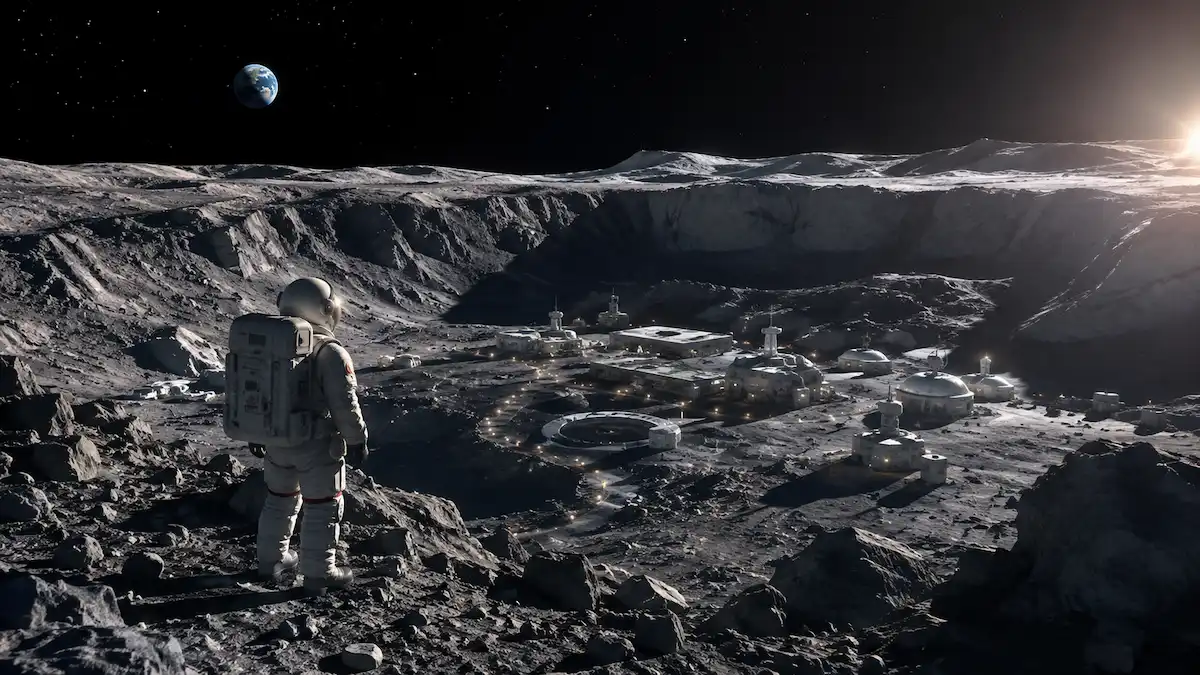
While the Moon South Pole may seem like the last place humans ever want to inhabit; however, what it has to offer could prove to be incredibly essential for any future lunar base, such as: water sources, sunlight, accessibility to scientific research, and land forms that could make for great lunar base construction sites. In fact, unlike the familiar territory near the equator where Apollo missions landed, the Moon South Pole has some areas of complete darkness while other nearby areas would see extended periods of daylight.
NASA has an interest in the Moon South Pole for future expeditions and a Moon base due to its natural resources and scientific research potential. But the mission to build a Moon base at the South Pole will not be easy. The Moon South Pole has its share of challenges, including a landscape of sheer- sided craters, rocky ground, extreme temperatures, and places that have not seen the light of day in millions of years. So, what makes this region of the moon so desirable? Five scientific reasons why the moon South Pole could become an essential region on the moon are as follows:
1. Water Ice Could Become the Most Valuable Resource at the Moon South Pole

The primary reason scientists are so interested in the Moon South Pole is water. NASA along with other lunar missions has gathered evidence supporting the existence of water ice in the craters of the Moon. The current researches conducted by NASA also suggest that water exists on both shadowed and sunlit regions of the Moon; scientists are still gathering evidence on how, where, and how much water exists on the Moon.
The reason why this discovery is historic is because of the high cost of transporting material to space. With a space station on the moon, researchers could utilize the water they find on the moon rather than spending money trying to bring water up into space. Water could sustain astronauts, but the real reason why water is advantageous to NASA’s cause is because of its molecular structure. Water is comprised of two atoms, hydrogen and oxygen. When separated through a process called electrolysis, oxygen could potentially be used as an aid to human life since it is required for human survival. Hydrogen could also be used as fuel along with oxygen for spacecrafts. Water has the potential to be integrated into NASA’s plan for a transportation fuel system between Earth and the Moon. The process of utilizing materials at a location to which you have traveled is often referred to as In-situ Resource Utilization, or ISRU. Instead of NASA having to bring everything they need to the moon, they could use what they find there. NASA is excited about the potential to use resources on the Moon South Pole.
2. Permanent Darkness Could Preserve Ancient Water and Other Volatiles
The moon, South Pole has an intriguing characteristic known as permanently shadowed regions (PSRs). The permanently shadowed regions define those places on the moon that are covered with shadows due to several reasons.
Due to the moon’s axial tilt of only 1.5 degrees, the sun appears very low on the horizon. This causes some places on the moon to be extremely cold. Within the permanently shadowed regions, temperature can dip as low as -203° C, and it can go as high as 54°C, the same as the hottest temperature on Earth. The permanently shadowed regions on the moon south pole are important for two different reasons. First, sunlight is critical to heating the ground and causing volatile materials to evaporate. But within the shadowed regions, there is no constant exposure to sunlight. This means that on the coldest parts of the moon, there is a significant chance for cold places like this to trap molecules like water. These are referred to as cold traps. The ice that is formed within the cold traps also stores the signatures of the materials that were implanted long ago into the lunar surface by comets, asteroids, and micrometeorites, as well as the solar wind. Therefore, the moon south pole is not only valuable because of the water ice. It also retains the fingerprints of the materials that have been striking the moon’s surface for billions of years.
YOU MAY LIKE
- Milky Way’s Black Hole Is Slowly Destroying Itself to Power Cosmic Rays”
 Milky Way’s black hole may be doing something scientists never expected. It is sacrificing a piece of itself to power some of the most energetic particles in our galaxy. A theoretical study suggests that Sagittarius A*, the supermassive black hole present at the center of the Milky Way, could be using its own spinning energy… Read more: Milky Way’s Black Hole Is Slowly Destroying Itself to Power Cosmic Rays”
 - New Tesla Roadster Takes Flight — But Elon Musk’s Original Car Is Still in Space
 This week, Tesla Roadster comes twice in the news for two very different reasons. On October 15, 2026, Tesla showed off a new Roadster prototype in Texas that appeared to lift off the ground using thruster technology inspired by SpaceX. While the new Roadster was making headlines on Earth, the original red Tesla Roadster that… Read more: New Tesla Roadster Takes Flight — But Elon Musk’s Original Car Is Still in Space
 - Astronomers Find the First Green Star – Could Our Sun Also Glows Green After it Dies?
 Astronomers just found the first green star and the reason of its unusual color is surprising. Astronomers at the University of Warwick have detected a dead star that actually looks green to the human eye, something that never confirmed before research. Scientists believe that the star has gained this green color because it consumes some… Read more: Astronomers Find the First Green Star – Could Our Sun Also Glows Green After it Dies?
 - Microblazar Discovered In Our Galaxy, After 30 Years of Searching And Its Jet Is Pointed Straight At Earth
 Recently a microblazar has been confirmed in our own galaxy, Milky Way. Scientists have been investing this cosmic mystery for nearly 30 years. The study reveals that the object named IRAS 18293-0941 sits about 1200 light years away from Earth and one of its powerful jets points straight towards the Earth. It sounds danger but… Read more: Microblazar Discovered In Our Galaxy, After 30 Years of Searching And Its Jet Is Pointed Straight At Earth
 - Orionid Meteor Shower: The Ancient Shooting Stars That Left By Halley’s Comet Centuries Before You Were Born
 The Orionid Meteor Shower returns this month, and brings beautiful streaks of lights and fill the dark sky with colours. Each meteor burning up in the sky is a tiny piece of dust that left behind by the Halley’s Comet hundreds of years ago. Now centuries past, and when Earth passes through this old trail… Read more: Orionid Meteor Shower: The Ancient Shooting Stars That Left By Halley’s Comet Centuries Before You Were Born
3. Nearby Sunlight Could Provide a Powerful Energy Advantage
One of the most interesting aspects of the Moon South Pole is that places of permanently shadowed darkness and regions offering maximum solar power potential can occur just a few kilometers apart. While deep crater floors maintain their shadow, their edges and the elevated areas around them are rich with solar energy potential. NASA is particularly interested in these areas as possible sites for solar power plants and human exploration. This is especially true when it comes to areas near Shackleton crater.

This is critical to address since at many places on the Moon, a day and night lasts for about two weeks. Solar panels would be unable to supply enough power during the long night that occurs during the winter near the poles. Therefore, for extended missions, there is a need for an alternative source of energy. While at the poles, this problem is less severe due to a combination of reasons.The reason for that lies in the fact that the Moon has an axial tilt of about 1.5 degrees. Due to the moon’s curvature, sunbeams touch the horizon at a very low angle, and high and steep places allow soaking up sunlight from it for a surprisingly long time. Yet, on the Moon South Pole, not all places are treated equally. Variations in illumination are particularly important around craters. They largely depend on their location and elevation above the surrounding area. Therefore, future moon travelers might need to find an area where solar power potential and access to water-rich deposits are balanced. Hence, it appears that the location of future lunar bases needs to be selected with care to take into account the availability of solar power during night and the accessibility of water sources.
4. The Same Terrain That Makes the Moon South Pole Valuable Also Makes It Dangerous
The Moon South Pole can be a good place for us to explore, but I doubt that it would be an easy area for us to build a base. The area around the Moon South Pole is a rough terrain of craters, cliffs, mountains and dips. The Sun is very low on the horizon here, causing very long shadows from obstructions. This makes it very difficult for us to see things like craters, cliffs, and other objects. A landing site that looks good to us could actually be very dangerous for us because of all the steep cliffs and big boulders around the landing site.
Another factor we have to consider is temperature. Solar energy can heat up some components while cooler regions are sheltered and untouched by sunlight, meaning there are dramatic differences in temperature. For this problem we need to find solutions in order to make our future missions easier. Another thing that may be a problem for us is the lunar dust. This fine, sharp and abrasive substance coats everything on the moon, from small pebbles to craters. This dust can get on our machines, clothing, and even our faces. NASA is working on some innovations for us to better understand this substance on the moon.
Now you know why it may be hard for us to find the best spot for landing. With all of the complications we need to consider including sunlight angles and shadows, cliffs, mountains, dips, communication relays, temperatures, resources, landing spots, and distances for travel to specific places, lunar exploration will be challenging. Now you understand how NASA could benefit from finding the best places to land near the Moon South Pole for the Artemis program.
5. The Moon South Pole Could Preserve Clues About the Early Solar System

Another reason why the scientists would be interested in the Moon South pole is because there might be some clues about the moons ancient past and the early solar system. Since the moon doesn’t have an atmosphere, water, or plate tectonics like the Earth does many things have been preserved for eons. The Moon South pole has many craters and some places that are very heavily shadowed which means if there was water ice or other volatile matter it could stay preserved under the cold temperatures for long periods of time. This volatile matter could help scientists understand more about how the moon was formed and evolved through time.
Many scientists are trying to get funding to go to the Moon’s South pole and study the possible deposits left behind from asteroids and other space matters. The deposits could provide more information about how water and other volatile matter could be transported to certain places in the solar system. This means that moon South pole could be much more than a resource, it could be a gateway providing information for the moons ancient past and maybe even our solar systems.
Conclusion
The Moon South Pole has features that could be beneficial for future exploration. From permanently shadowed areas, which have water ice and other volatiles, to areas of higher ground that have a constant supply of sunlight, to ancient formations that can provide insight on the moon and the solar system, they would all be extremely useful for humans. However, The area can be very dangerous with its rough terrain, extreme temperatures, variable lighting conditions, and even the fine dust could prove challenging for electronics, vehicles, equipment, and even astronauts themselves. The Moon South pole is more than just an option for a lunar base that will be used for similar purposes as the Apollo program. The Apollo missions were mainly for exploring, scientific discovery, collection of samples for analysis, and returning them along with photographs to Earth. But these missions were only brief visits, whereas the question for further exploration of the Moon is really about whether humans can learn to live on another world.
If we can make use of local materials, generate electricity, construct buildings, and withstand the elements, The Moon South Pole may just be our ticket to further exploration of our solar system and beyond. The Moon South Pole is a worthy site for consideration as a location for a lunar base. It’s value extends beyond being a mere location, it could be a starting point for humanity’s expansion into, and colonization of, another world.