

A pulsar feeding on stellar wind is really interesting. NASA and JAXA have just witnessed the process occur in real-time. Using the XRISM X-ray observatory, astronomers observed a stream of gas coming from a large star into its compact companion at speeds of approximately 335,000 mph (540,000 km/h). Scientists are now getting how a neutron star consuming material from its companion star and converting the captured material into X-ray flares. This star system is called BP Crucis and it is located about 13,000 light-years away from the earth in the constellation Crux. BP Crucial star system contains a blue supergiant named Wray 977 and a less massive neutron star called GX 301-2. Together both makes a high-mass X-ray binary system which produces X-rays when the denser star absorbs some material from its companion star.
What Does “Pulsar Feeding On Stellar Wind” Means?
To understand pulsar feeding on stellar wind properly, let’s look at the two distinct objects in this system.
- First is Wray 977 and it is very massive. NASA calculated that it has a mass of about 40 times the suns’ mass and has a radius of approximately 60 to 62 times that of the Sun. Due to the extreme hotness and brightness of this star, gas is constantly being blown off from its outer layer into space, forming what’s known as a stellar wind.
- Another object is its companion star called GX 301-2. This object is completely opposite of first one, it is a neutron star, crushed core that left behind after a massive star exploded as a supernova. It has more mass than sun but its mass is packed in a small sphere of about 12 miles (20 kilometers) across. This neutron star GX 301-2 also rotates once in every 11 minutes. When it rotates, it produces a beam of X–rays and directing it towards the Earth. That beam sweeps across our line of sight so that astronomers classify GX 301-2 as a pulsar.
A pulsar feeding on stellar wind event happens when a neutron star passes through a nebula of gas that is passing from its larger and hotter companion. The gas is absorbed by the pulsar’s gravitational field, forming an accretion disk around it, which then can make a hot spot which may emit high-energy X-rays.
Why Does This Pulsar Produce Powerful X-Ray Flares?
The orbit of GX 301-2 around Wray 977 takes approximately 41.5 days. During this period, the pulsar passes through a region of the massive star where stellar winds are strongest. Due to the gravitational pull of the neutron star, a focused stream of plasma forms in the direction of the pulsar. When the pulsar moves into this stream, it captures some of the gas and make its X-rays much brighter.

One of the most interesting things about a pulsar feeding on stellar wind is right here. According to the text, NASA discovered strong X-ray flares happen twice during the pulsar’s orbit, near its closest and farthest points from the giant star. The flare is strongest when the pulsar orbits at the closest point to Wray 977, which has a stronger stellar wind. When the pulsar passes through the region of dense streams, it takes around 4 days to move through this area. During this time, the structure of the material surrounding the neutron star changes.
First, the captured matter can form a thick and turbulent accretion disk around the pulsar. Gas flows down this disk and heating up as it reaches near the neutron star and producing X-rays. But, as the GX 301-2 moves further into the stream of stellar wind, this orderly flow can be disrupted. There may not be enough angular momentum present in the incoming gas to maintain the accretion disk. Then the flow of plasma can become more chaotic. Another possibility is the later formation of another turbulent disk when the pulsar moves into the end of the stellar wind stream. NASA noted that the later disk can rotate in the opposite direction from the earlier disk, because the direction of the flow of material has changed. The varying structure of the material around GX 301-2 makes it a great natural laboratory for observing the characteristics of a pulsar feeding on stellar wind.
How Did XRISM See the Gas Falling Toward the Pulsar?
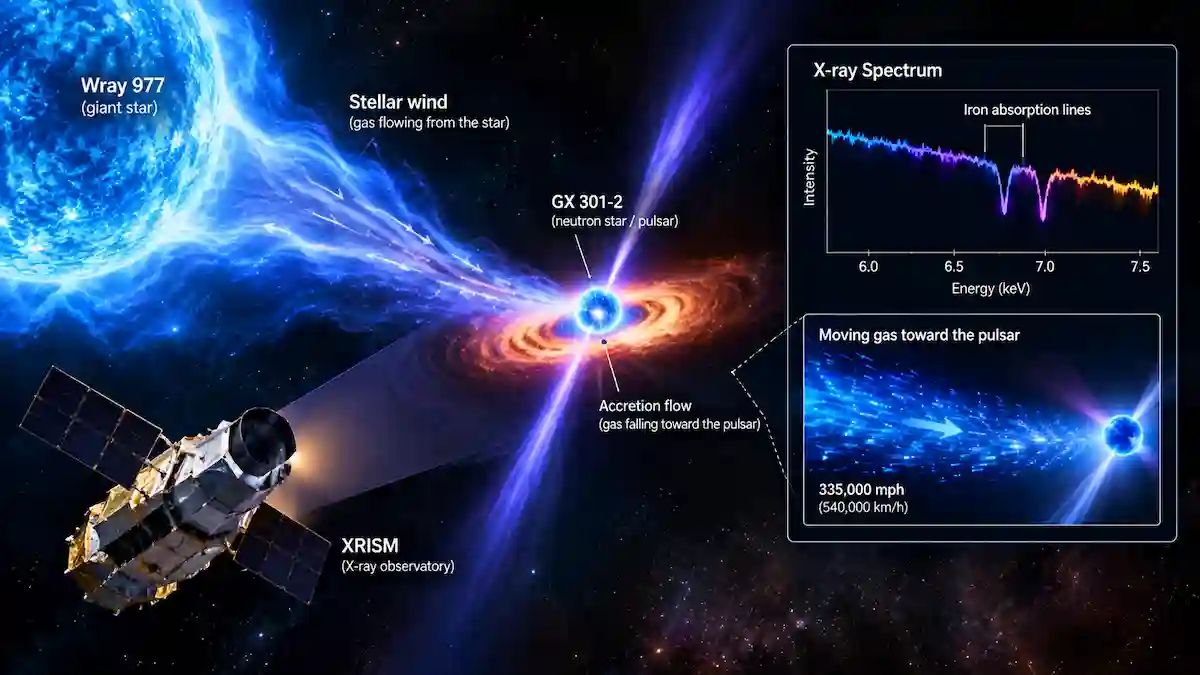
Astronomers have been studying how neutron stars collect material from their companion stars’ stellar wind. But seeing directly this whole process is much more difficult. So, to take a closer look at BP Crucis, scientists directed XRISM at the system on 1 February 2025, and they kept the telescope on the target for nearly 16 hours during the end of one of the strongest X-ray flare. XRISM’s Resolve spectrometer (provided by NASA and JAXA) had captured a detailed of information about the hot plasma.
The most prominent clue was created by highly ionized iron. When atoms of an element are moving in a gas, this creates a Doppler shift in the spectral absorption lines. This shift can be used to determine how the gas is moving. Here the Iron absorption lines show that plasma was moving towards the GX 301-2 at the speed of about 335,000 mph (540,000 km/h). In simple words X-ray spectrum acts as a cosmic speedometer for incoming gases. That’s a big find for a pulsar feeding on stellar wind because it connects the stellar wind blowing from the giant star to the material flowing toward the neutron star.
YOU MAY LIKE
- Radio Signal From Exoplanet Detected for the First Time, and It’s Not Aliens
 A radio signal from exoplanet Beta Pictoris b has just been confirmed by astronomers. This is the first time when scientists have directly traced radio waves to a single planet outside our solar system rather than to its host star. Before you get too excited about first contact, here’s the twist: this radio signal from… Read more: Radio Signal From Exoplanet Detected for the First Time, and It’s Not Aliens
- NASA Starliner Update: Boeing’s Troubled Spacecraft Won’t Fly Astronauts Until 2028
 NASA Starliner Update just came out, and it answers a question many people have been asking since 2024; when will this spacecraft carry astronauts again? On Monday, September 28, NASA and Boeing held a press conference at Kennedy Space Center to share a new plan for the Starliner program. Here is the short version: an… Read more: NASA Starliner Update: Boeing’s Troubled Spacecraft Won’t Fly Astronauts Until 2028
- Starship Flight 14 Result: Reaches Orbit, Deploys 26 Starlink Satellites, Ends Early
 The Starship Flight 14 result is a success with one major catch. SoaceX’s Starship is the largest and most powerful rocket in the world. And it reached the Earth’s orbit for the first time on Monday, September 28. It lifted off from Starbase, Texas, at 7:48 a.m. CT (8:48 a.m.EDT). This mission delivered 26 upgraded… Read more: Starship Flight 14 Result: Reaches Orbit, Deploys 26 Starlink Satellites, Ends Early
- Swift Telescope Rescue Mission Failed: What Happens to NASA’s 22-Year-Old Observatory Now
 The Swift Telescope Rescue Mission has failed, and scientists expect that NASA’s Neil Gehrels Swift Observatory fall back to earth and burn in the atmosphere by early November. A company name, Katalyst Space Technologies was handling the rescue mission, which cost about $30 million. In the mission, they planned to use a robotic spacecraft name… Read more: Swift Telescope Rescue Mission Failed: What Happens to NASA’s 22-Year-Old Observatory Now
- James Webb Just Found the Smallest Brown Dwarfs Yet — And They’re Challenging How Stars Are Born
 NASA’s James Webb just found the smallest brown dwarfs ever discovered. JWST spotted a group of brown dwarfs in the young star-forming region IC 348. Scientists estimate these objects are so light that their mass is only about twice the mass of Jupiter. These objects are too small to become normal stars, but they may… Read more: James Webb Just Found the Smallest Brown Dwarfs Yet — And They’re Challenging How Stars Are Born
Why This Discovery Matters?
A pulsar feeding on stellar wind from a companion star is an example of accretion, the process by which matter falls toward a compact object under gravity. Accretion is one of the most important processes in high-energy astronomy, as it can generate enormous quantities of radiation when gas falls toward neutron stars and black holes. But the behavior of the gas can be complicated by gravity, orbital motion, magnetic fields, radiation, and the movement of the surrounding plasma. BP Crucis provides a natural laboratory because the neutron star repeatedly passes through the dense wind from its companion.
Researchers can therefore investigate how the accretion process varies as the pulsar moves through different parts of the stream. XRISM provides another key benefit that its Resolve instrument can measure X-ray energies with extreme precision, allowing astronomers to probe the spectral fingerprints of the material around the neutron star. Instead of just seeing the system is bright in X-rays, scientists can investigate the state of the gas, what elements are present and how fast the material is moving. That means observations of a pulsar feeding on stellar wind from a companion star provide an opportunity for investigating models of wind-fed accretion.
Conclusion
The XRISM observation provides detailed information to astronomers about pulsar feeding stellar wind from its companion giant star. The most interesting thing is the speed of the material falling onto the compact object, almost 335,000 mph (540,000 km/h). A celestial object only 20 km in diameter captured the gas and more than our sun’s mass is packed within this small volume.
This discovery is significant, because it allows scientists to analyse the pulsar feeding on stellar winds more closely than before. Instead of only theoretical speculations, now there are actual measurements of how this flow of plasma impacts the surface of a neutron star. A pulsar feeding on stellar wind of its giant companion has become an unusual discovery. It has opened up new horizons for looking at the properties of matter in ultra-strong gravitational fields, as well as in superheated states. As XRISM continues its observation of the X-ray universe, further observations of BP Crucis and similar binaries may give some information about how matter behave when it pulled by some densest object present in the space.