
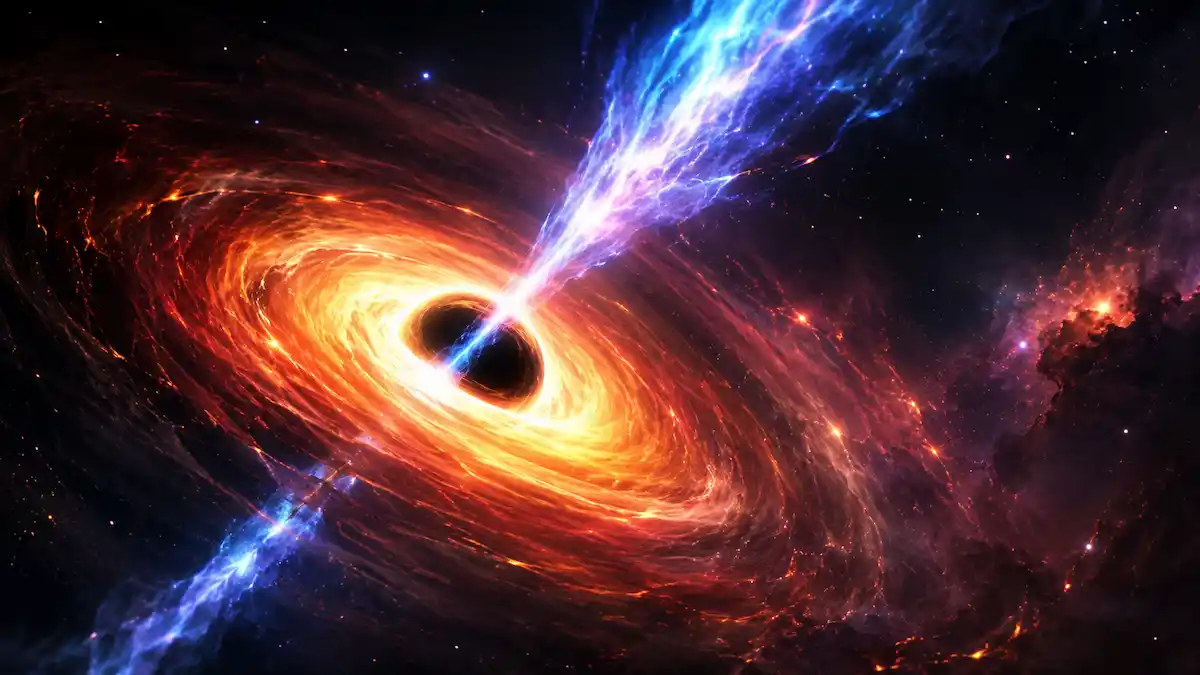
What are black hole jets and how can such tightly focused streams of plasma is produced at such great distances from the source? Some theories suggest a rapidly rotating accretion disk, strong magnetic fields, a stream of relativistic plasma, and in some cases, extracting rotational energy from the black hole itself. These jets are one of the most powerful phenomena in the universe.
Jets are not formed by the material inside the event horizon. They are formed from the environment around the black hole which is being intensely funneled due to the strong gravitational forces of the black hole. One must look elsewhere than the event horizon to understand the nature of black hole jets.
What Are Black Hole Jets and Where Do They Come From?
To learn about what are black hole jets, let’s begin by imagining a black hole that is accreting matter. A black hole does not really have a surface from which it could expel some materials. The matter which is swallowed by a black hole not just disappear, it forms a super heated accretion disk around the black hole. The gravitational energy converts into heat and radiations as the matter moves inside. This makes inner part of the disk extremely energetic environment.
Thus, one can imagine extremely hot plasma which is whirling around the black hole at a very high speed. Since the plasma is electrically charged, it is strongly influenced by magnetic forces. The magnetic field lines could be twisted around the black hole due to the rotation of an accretion disk. Such a phenomenon could cause the acceleration of charged particles to very high speeds. NASA explains this process as ‘fields are twisted by the rotating accretion disk’.
They are also responsible for producing a narrow powerful stream of particles called “jet” in the form of super heated plasma. This is the basic physical picture behind what are black hole jets. The jet from a black hole could be bipolar, meaning that there might be two opposing streams of plasma flowing from the black hole. The flow of the jets is collimated along the axis of rotation of the black hole. One jet is pointing up and another jet is pointing down the disk.
Why Do Black Hole Emit Radiation?
What Are Black Hole Jets Actually Made Of?

Another important question about “what are black hole jets” is their composition.
Black hole jets contain extremely energetic plasma and charged particles, but scientists are still studying their exact composition. Electrons are known to be an important part of many jets. Some jets may also contain their antimatter partners, called positrons, while others can contain heavier particles such as protons or atomic nuclei. Observations of some stellar-mass black hole systems have provided evidence for heavier particles in their jets. The compositions of jets are significantly interesting and important because they are not created from the matter which fell into the black hole and could somehow escape its gravity. Instead, they consist of the particles from the jet’s accretion disk environment, which were accelerated to relativistic speeds before crossing the event horizon and never returning.
In addition, jets also have immense energy, part of which goes into accelerated particles generating various types of radiation, ranging from radio waves to optical, X-ray, and gamma-ray photons. This radiation can be picked up by radio telescopes, optical telescopes, X-ray satellites, and gamma-ray detectors. Relativistic particles in jets emit synchrotron radiation when moving at relativistic speeds in magnetic fields. This type of electromagnetic radiation is very important because it allows scientists to observe magnetic fields and other charged particles in jets since these phenomena are invisible to see directly. This is why the most critical observations of what are black hole jets come from radio and X-ray telescopes.
How Does Hawking Radiation Work?
How Magnetic Fields Turn an Accretion Disk Into a Cosmic Launching System
The most important aspect of what are black hole jets concerns the nature of magnetic fields. An accretion disk is not just a ring of hot gases. It is a highly turbulent region of plasma, which consists of charged particles. These particles are moving around the black hole, their movement results in interaction with the magnetic field. As the accretion disk rotates, it can twists and stretches the magnetic field lines of the black hole. These magnetic field line acts as invisible pathways for some of the particles plasma in getting away from the central region of the black hole. Magnetic fields also help these particles to focus into a narrow stream along the black hole’s rotational axis, instead of spreading in every direction.
NASA’s latest findings on the jet of our neighbor galaxy M87 provide another confirmation of the magnetic field hypothesis. According to the researchers who worked on the Hubble Space Telescope images, the plasma in M87 jets reaches close to the speed of light and follows the pattern of a huge, possibly helical, magnetic field. Thus, the part of the jet visible from Earth spans 5,000 light-years.
One important theoretical model for this is the Blandford–Znajek mechanism. It proposes that magnetic fields connected to the region around a rotating black hole can extract some of the black hole’s rotational energy and transfer it into an electromagnetic outflow. This means that the enormous power of some black hole jets can come from two connected sources: the energy released by matter falling through the accretion disk and, in some systems, energy extracted from the rotation of the black hole itself.
How Far Can Black Hole Jets Travel and Can They Affect Galaxies?

Black hole jets can travel enormous distances, sometimes extending far beyond the central region of their host galaxy. These powerful black hole jets can strongly affect their surrounding galaxies. Super massive black hole which is actively feeding on gas and surrounding matter produce powerful jets of high energy plasma. Intense magnetic fields accelerate these plasma articles to speeds close to the speed of light. As these jets travel from the black hole, they can interact with the gases in the galaxy and release enormous amounts of energy. This energy heats the material up, pushes it away, and even creates large radio-emitting structures called lobes and cavities. The process is referred to as black hole feedback. It also affects the amount of cold gas in the system, which determines the rate of star formation processes.
The Messier 87 galaxy is a famous object for observing such jets, as its massive black hole produces a polar jet almost 5000 light years long. However, there are also more extreme examples of radio galaxies, such as the Centaurus A, whose jet structures span about a million light years long. Therefore, it can be concluded that most jets produced by black holes are several thousand light-years long. In extreme cases their effect can reach for hundreds of thousands of light-years or even more.
Secondly, they can affect galaxies by heating and disturbing surrounding gases; these jets can influence star formation and also play an important role in galaxy evolution. That is what makes what are black hole jets such an important question, not only for understanding black holes, but also for understanding how galaxies change over time.
Conclusion
So, what are black hole jets at the deepest level?
They are narrow powerful jets of relativistic plasma and electromagnetic energy generated by the intense physical processes near the active black hole. It is not the matter from inside the event horizon but the magnetic field surrounding the black hole propels it outward in the form of collimated jets. Then they are accelerated and focused by the rotational energy of the spinning black hole or the energy from an accretion disk that surrounds it.
Scientists are still trying to find answers. They want to know why some active black holes eject jets of energy while others do not. They are seeking to explain how particles are energized to such high speeds, and how magnetic fields can penetrate such long distances. By studying hundreds of quasars has uncovered that the spin of a black hole may not enough to produce powerful jets alone. A strong, magnetized corona surrounding the black hole also plays an important role. That makes black hole jets much more than just incredible displays of light. They provide a natural laboratory where the fundamental forces of nature can be studied. Ultimately, what are black hole jets? They are huge flows of energy from a black hole, able to carry power across thousands of light years. Jets can influence the formation and evolution of galaxies.