
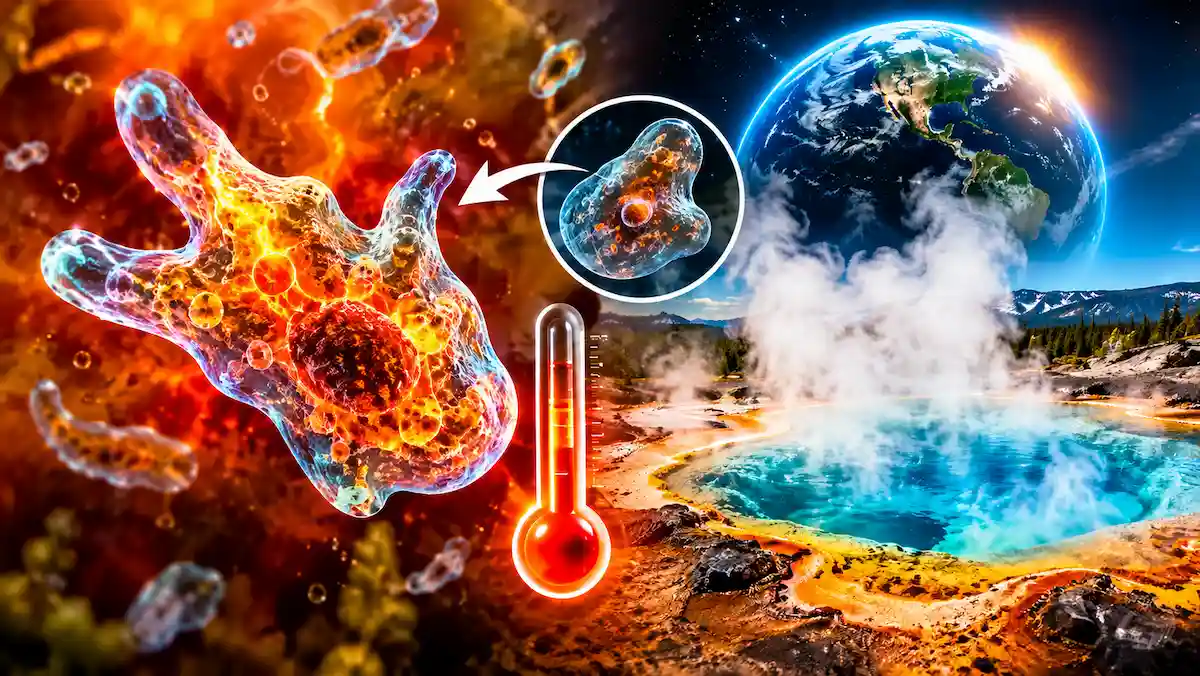
NASA funded a mission to see for highest temperature life can survive. It results a newly discovered tiny organism which lives in the hot springs of California and it has the ability to survive on surprising temperature 63°C (145°F). This organism is a newly described amoeba called Incendiamoeba cascadensis, nicknamed the “fire amoeba.” Researchers found that it can actually reproduce at 63°C. At 64°C, it stops reproducing but still remains active and move around and search for food.
The interesting part is; scientists are not studying this strange creature just because it can survive extreme heat. Organisms like this can help researchers to understand where life might be able to exist beyond Earth. If life can survive on places which we earlier though too extreme on our planet, then scientists need to expand their search for life beyond earth.
But there is an important catch. 63°C is not the temperature for any life to survive on Earth. Only some bacteria and archaea can tolerate this temperatures and survive. This new record belongs to a group of life called eukaryotes (which includes animals, plants, fungi, and amoebas), but only this specific amoeba can actually survive that heat. So, what does this tiny “fire amoeba” actually tell us about the highest temperature life can survive?
What Is the Highest Temperature Life Can Survive?

Before talking about the new record, there is something important to understand: The highest temperature life can survive is not the same as the highest temperature at which an organism can grow and reproduce.
Imagine putting a living organism into an extremely hot environment. It might survive a short burst of heat without being able to grow. It might even remain active for a while. But that does not necessarily mean it can complete its life cycle there. For scientists, reproduction is a much stronger test. In the case of Incendiamoeba cascadensis, researchers found that the amoeba can divide and reproduce at 63°C (145°F). That makes 63°C the new known upper temperature limit for reproduction among eukaryotes. The previous record was around 60°C (140°F), held by certain fungi and red algae.
At 64°C (147°F), things get even more interesting. The amoeba stops reproducing, but it can still remain active, moving through the hot water and searching for food. Laboratory experiments pushed it further. The organism could remain partially active at 66°C (150.8°F) and recover after being exposed to 70°C (158°F) for five minutes. At 80°C (176°F), however, the heat was too much for it to recover. So if someone asks about the highest temperature life can survive, we should not simply answer “63°C.” The more accurate answer is that 63°C is the current record for reproduction among known eukaryotic life, while this particular organism can tolerate even higher temperatures for shorter periods. That distinction makes the discovery much more interesting.
Meet the Fire Amoeba Living in a Volcanic Hot Spring

The organism responsible for this record was found in Lassen Volcanic National Park in California, an area which is filled with geothermal activity. Unlike an ordinary pond, these geothermal environments can become incredibly hot. But they are not lifeless. Microorganisms have evolved to make use of these extreme conditions.
Incendiamoeba cascadensis is an amoeba, meaning it is a single-celled eukaryotic organism. Its scientific name reflects its unusual lifestyle: “fire amoeba from the Cascades.” Researchers found it in a near-neutral-pH geothermal environment. The amoeba feeds on heat-loving bacteria, while the extreme temperature may help keep competing organisms and predators away.
Think about that for a moment. For most organisms, extreme heat is a problem. But for this amoeba, extreme heat may actually create a relatively quiet neighborhood with plenty of food and fewer competitors. That could be one reason this organism has evolved such an impressive heat tolerance. Finding the highest temperature life can survive is about more than just setting a number. Scientists want to know how an organism turns an environment that looks deadly to us into a place where it can actually live.
How Can a Complex Cell Handle So Much Heat?

Heat is extremely hard on cells. At high temperatures, proteins can lose their proper shape, DNA can get damaged, cell membranes and other structures can become unstable. For a complex eukaryotic cell, it creates a huge problem. Eukaryotes have a nucleus and many specialized structures inside their cells. There is simply more delicate cellular machinery that has to keep working properly.
Scientists had suggested that some membrane structures inside eukaryotic cells would break down at temperature above 62°C. But the discovery of new organism named, Incendiamoeba cascadensis proves that life can survive on much higher temperatures. Scientists have read the complete DNA blueprint of an amoeba and examined how its genes responded at different temperatures. They found some systems active on the body and help to keep DNA stable, notice environmental changes, and maintain proteins fold correctly.
Some of its proteins also have highly positive charges on their surface, similar to heat-loving bacteria and archaea. In simple terms, this tiny organism have special molecular mechanisms that help its cells keep working even at extreme temperatures. For scientists, highest temperature life can survive is not just a new record. It provides clues about how complex cells can adapt and survive in extremely hot environments.
Why This Changes the Search for Life Beyond Earth?
This is where the story moves from a hot spring in California to the wider universe. NASA and other space agencies are deeply interested in extremophiles because Earth is the only world we currently know that support life. If scientists want to know where life could exist other than earth, one useful approach is to first understand the limits of life here.
That’s why the highest temperature life can survive matters to astrobiology. Suppose scientists discover a planet or moon with an environment that looks extremely hostile. If its temperature is too hot for most of the living organisms then it is normal to think that nothing can survive there. But assumptions like this can be risky. Life can sometimes adapt to conditions that seem impossible based on our previous assumptions. NASA specifically says that studying extremophiles helps researchers to understand the biochemical and physiological limits of life on Earth and search for environments where life could potentially exist other than earth.
Could Hot Worlds Support Complex Life?
This is the question that makes the new highest temperature life can survive record especially relevant to space science. Our Solar System contains worlds with dramatically different temperatures and environments. For example, Venus has a surface temperature of around 465°C (869°F), which is far beyond the range showed by the fire amoeba. NASA’s upcoming DAVINCI mission study the Venus’s atmosphere and investigate about the planet’s past, and check if the hot planet once had water and could support life like Earth in past.
So this discovery does not suddenly make Venus habitable. Instead, it helps scientists better understand where the biological limits of complex life actually lie. The difference is important. Because earlier, researchers had never seen a complex cell that reproduce above 60°C, but now they know that at least one eukaryote can reproduce at 63°C.
Scientists compared genetic data from geothermal environments around the world and found related DNA in samples from New Zealand and Yellowstone National Park. This means that may be other heat-loving amoebas related to I. cascadensis could exist in geothermal environments elsewhere. So the current highest temperature life can survive record may not be the final number.
Conclusion
So, what is the highest temperature life can survive? For known complex life, the current record is 63°C (145°F) for reproduction. Thanks to the remarkable fire amoeba, Incendiamoeba cascadensis.
The real importance of this discovery goes far beyond a new temperature record. It shows that some complex organisms can handle heat far beyond what scientists once expected. And for NASA scientists, this is especially important because every new biological limit gives them another clue about where they should look in searching for life beyond earth. We still don’t know whether 63°C is the ultimate boundary. There could be other organisms hiding in Earth’s extreme environments that can push it even higher.
For now, one thing is clear: the highest temperature life can survive is not a fixed number. The boundary has just moved and scientists are still discovering how far life can go.