
If you have seen the Roman Telescope first image online this week, your first thought was probably that something went wrong. The stars look like glowing rings and donuts instead of sharp points of light. NASA says the Roman Telescope First Image was taken as an initial performance test while the telescope’s detector array was still in its launch configuration and far from its best focus. NASA expects to release Roman’s first real images by early 2027. Let’s dig into the NASA’s new observatory and see its first blurry image and how it helps scientists to explore the universe in future.
Roman Telescope Could Last 22 Years After NASA Saves Huge Amount of Fuel
Roman Telescope First Image
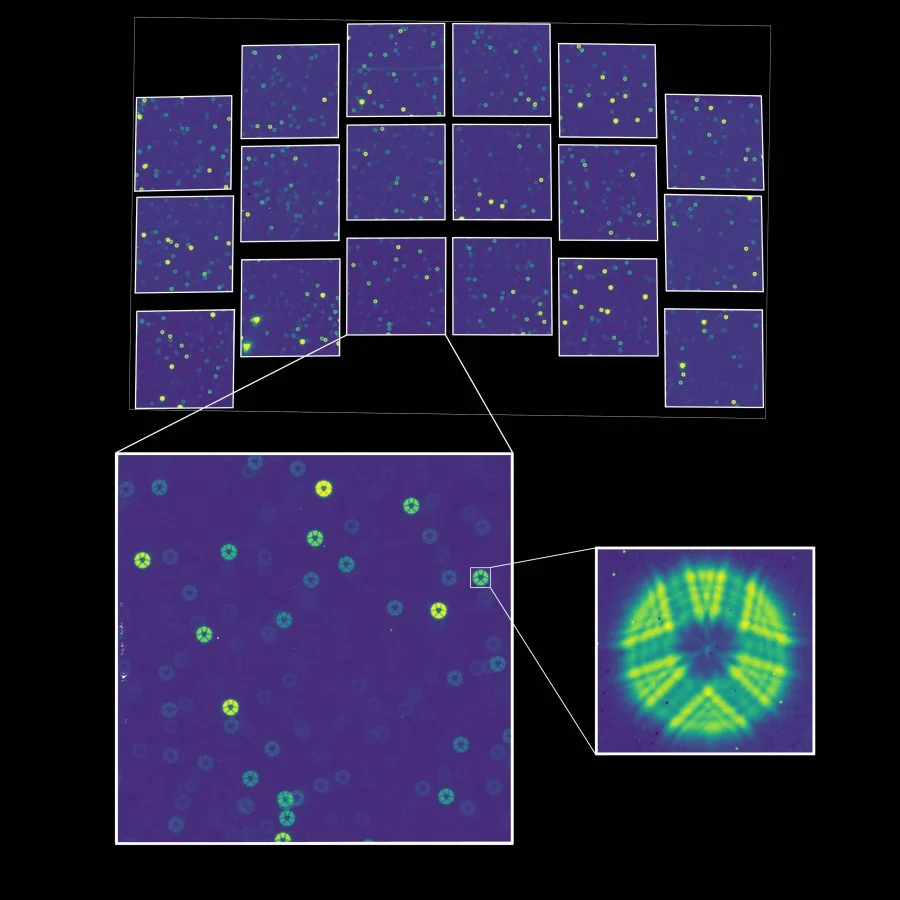
Image Credit: NASA’s Goddard Space Flight Center / Tyler Desjardins (STScI)
Roman telescope first image is a test photo taken shortly after the telescope was launched into space by SpaceX Falcon Heavy rocket from Kennedy Space Center, Florida on August 30, 2026. The Roman’s main camera, the Wide Field Instrument (WFI) was turned on September 11, and NASA shared the result, blurry image in a blog post on September 15. You can think first image as a starting health check up. By this engineers can learn that the camera is working in space properly. Josh Schlieder, an instrument scientist said that team has now confirmed that the camera is working in space, but still a lot of work remain to do.
This space telescope is named after the NASA’s first chief of astronomy, Nancy Grace Roman. She played an important role for pushing space telescopes so that she is also known as “Mother of Hubble”. Another important thing, if you are looking for the Roman Telescope first image, then you have to wait for some time. The picture which is available on various platforms is not a real science image of the mission, it is only a testing image to see whether the telescope instruments working properly. NASA expects to see Roman Telescope first image related to mission in early 2027.
Why the Roman Telescope First Image Looks Blurry?

At first glance, the image looks like a mess. Stars are appear broad and hazy and some are taking the form of rings or donuts. Some of them stretch for thousands of pixels. The reason is simple: Roman was not fully focused when the picture was taken. During launch engineers kept the detector assembly in a stowed position to protect the delicate detectors. Due to this detectors leave their intended focal locations. Besides, the telescope’s optics have not been adjusted yet. Imagine a camera that gives blurry image because it adjusted incorrectly. Starlight still reaches the sensor, but instead of converging to a point, it spreads out in all directions forming a ring. Nothing got broken in telescope’s instrument but the camera has not been adjusted yet.
After spacecraft reached the space, engineers had to carefully prepare the instrument before beginning its full testing program. NASA says the team first allowed the instrument to rest for about 10 days for drying and decontamination. Initially the detectors temperature was about −85 degrees Fahrenheit (−65 degrees Celsius). Then engineers turn off the heaters on September 11 and it make the instruments to cool about −225 degrees Fahrenheit (−143 degrees Celsius) before activating its 18 infrared detectors. The temperature is an important factor because these are infrared detectors, meaning they are super sensitive to thermal emissions. Unwanted thermal emission could interfere with the tiny amount of light that astronomers are trying to detect.
Once they were done, the engineers tested the WFI’s calibration system and its element wheel. It contains different kinds of filters, prisms, and other optical elements that control which wavelengths of light are allowed to pass through and into the sensors. They also did a check on the instrument’s focus. Only after these initial tests have been completed, scientists get the Roman Telescope first Image. So, calling this first image a “blurry image” is not a suitable term. It should be considered as the “first performance measurement” for the telescope’s commissioning.
The Camera Behind the Roman Telescope First Image
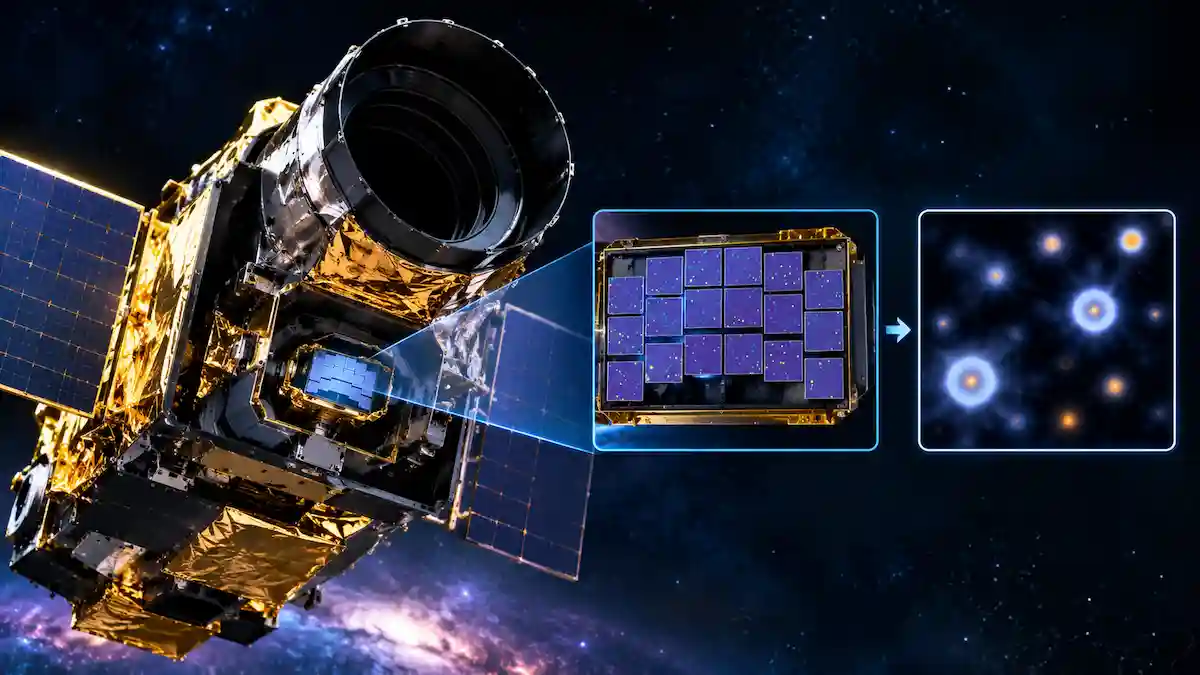
The weird look of the Roman Telescope first Image is only one part of the story. The reason astronomers are so excited is WFI’s wide field of view. Each WFI image will capture a large area of the sky, larger than the apparent size of the full Moon.
The Wide Field Instrument uses 18 infrared detectors and has 300-megapixels. The WFI’s field of view is about 0.8 by 0.4 degrees, or about 0.281 square degrees (excluding detector gaps), according to NASA’s technical specifications.
Why it uses infrared light?
Human eyes are unable to see infrared light. However, it provides the Roman with two significant advantages.
- First, it is easier to penetrate the dust between stars. Therefore, astronomers can see through this dust and observe some objects which are invisible to optical telescopes.
- And it is also valuable for studying distant galaxies because universe expands incredibly. The light which comes from these galaxies has longer wavelengths when it reaches us. As a result, it appears as infrared light.
The primary mirror of Roman is 2.4 meters in diameter, just like in Hubble. However, Roman has a broader field of view than Hubble, about 300 times bigger than that of the Hubble Space Telescope. Imagine looking at a city through a narrow straw versus a wide window. The Hubble can capture an extremely detailed view of a small area, while Roman can see a much bigger area at the same time. With this much broader view, Roman will be able to survey the universe many times faster than Hubble.
YOU MAY LIKE
- Radio Signal From Exoplanet Detected for the First Time, and It’s Not Aliens
 A radio signal from exoplanet Beta Pictoris b has just been confirmed by astronomers. This is the first time when scientists have directly traced radio waves to a single planet outside our solar system rather than to its host star. Before you get too excited about first contact, here’s the twist: this radio signal from… Read more: Radio Signal From Exoplanet Detected for the First Time, and It’s Not Aliens
- NASA Starliner Update: Boeing’s Troubled Spacecraft Won’t Fly Astronauts Until 2028
 NASA Starliner Update just came out, and it answers a question many people have been asking since 2024; when will this spacecraft carry astronauts again? On Monday, September 28, NASA and Boeing held a press conference at Kennedy Space Center to share a new plan for the Starliner program. Here is the short version: an… Read more: NASA Starliner Update: Boeing’s Troubled Spacecraft Won’t Fly Astronauts Until 2028
- Starship Flight 14 Result: Reaches Orbit, Deploys 26 Starlink Satellites, Ends Early
 The Starship Flight 14 result is a success with one major catch. SoaceX’s Starship is the largest and most powerful rocket in the world. And it reached the Earth’s orbit for the first time on Monday, September 28. It lifted off from Starbase, Texas, at 7:48 a.m. CT (8:48 a.m.EDT). This mission delivered 26 upgraded… Read more: Starship Flight 14 Result: Reaches Orbit, Deploys 26 Starlink Satellites, Ends Early
- Swift Telescope Rescue Mission Failed: What Happens to NASA’s 22-Year-Old Observatory Now
 The Swift Telescope Rescue Mission has failed, and scientists expect that NASA’s Neil Gehrels Swift Observatory fall back to earth and burn in the atmosphere by early November. A company name, Katalyst Space Technologies was handling the rescue mission, which cost about $30 million. In the mission, they planned to use a robotic spacecraft name… Read more: Swift Telescope Rescue Mission Failed: What Happens to NASA’s 22-Year-Old Observatory Now
- James Webb Just Found the Smallest Brown Dwarfs Yet — And They’re Challenging How Stars Are Born
 NASA’s James Webb just found the smallest brown dwarfs ever discovered. JWST spotted a group of brown dwarfs in the young star-forming region IC 348. Scientists estimate these objects are so light that their mass is only about twice the mass of Jupiter. These objects are too small to become normal stars, but they may… Read more: James Webb Just Found the Smallest Brown Dwarfs Yet — And They’re Challenging How Stars Are Born
What Happens After the Roman Telescope First Image?
After the Roman Telescope first image, it will continue its journey to its final destination which is about 1 million miles (1.5 million kilometers) away in the Sun-Earth L2 point. This place is located on the opposite side of the sun from Earth. By being in this location, the telescope will experience less interference and have a stable and cold environment to conduct its work. The James Webb Space Telescope will also be in the L2 point.
However, traveling to L2 is only a starting point for Roman’s journey. Engineers will continue to check the spacecraft’s systems and make preparations for conducting the telescope’s science mission. The team will test the Roman’s fine-guidance system to ensure that it can accurately target the telescope. Then, they will move the detectors to their correct positions while the optics are being adjusted by the engineers. This procedure is necessary since the first set of pictures may not turn out to be as clear. As the telescope adjusts, the stars will stop being spread out. They will appear as little points of light in images. Testing and calibration will take place for a few months.
In addition to being a significant milestone in the life cycle of the Roman telescope, this mission will also require an enormous amount of money. NASA estimates that the expedition will cost around $4 billion, and the spacecraft’s primary mission is expected to last for five years. There is enough fuel for a longer mission if everything goes well. According to NASA’s latest calculations, Roman could potentially last for at least 22 years since it saved enough fuel for its journey.
Conclusion
The Roman Telescope first image may not look pretty, but it will be important to the mission. It will show that the telescope’s camera is working, signals are getting back to earth, and Roman has been working properly after its long journey to space. After a few months, engineers will carefully focusing the telescope and adjusting its mirrors. After they are done, the Roman Telescope first image will look like nothing but a small, blurry spot compared to what Roman is ready to make. Roman is expected to begin delivering sharp scientific images in early 2027. These pictures could be the beginning of one of the largest, most detailed surveys of all space.