
Hubble Seeks Lensed Supernova is the story behind one of NASA’s most fascinating recent discoveries. Hubble Space Telescope has spotted the rare phenomenon of a supernova, the explosion of a star which will pass through a massive galaxy cluster. It is expected that it’s light will reach to earth more than once because that massive galaxy cluster bend its path in space. The Hubble Seeks Lensed Supernova picture is considered one of the most scientifically powerful images Hubble has captured in recent years, and it fell on a special night in the observatory’s history.
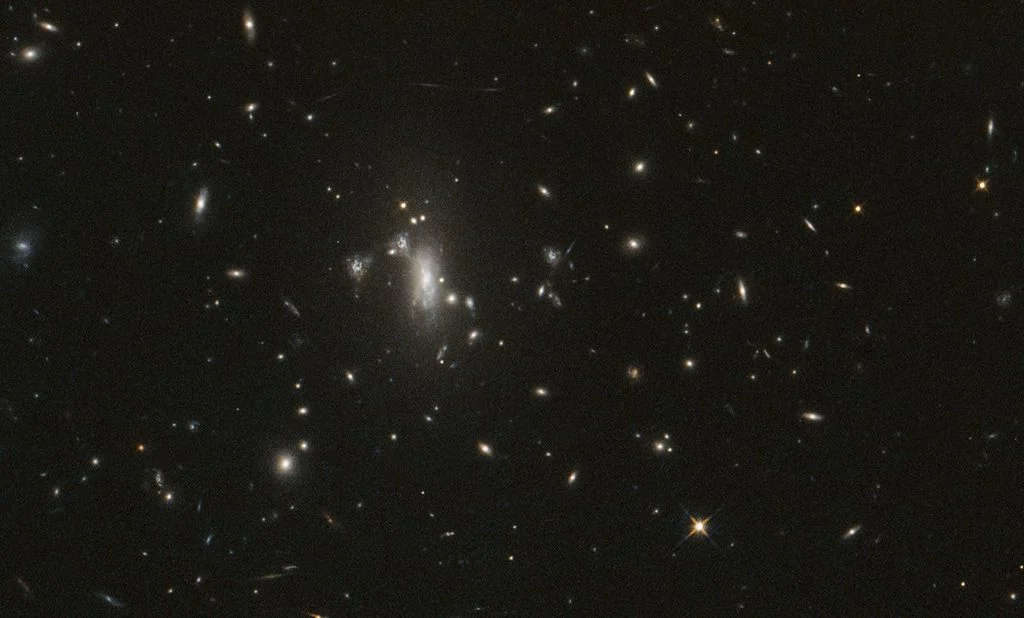
Credit: NASA, ESA, STScI, M. Pascale (UCLA); Image Processing: J. DePasquale (STScI)
The image of the supernova, which is part of the Hubble Seeks Lensed Supernova series, shows the galaxy cluster MACS J0417, which has an immense amount of mass. This includes the combined mass of thousands of galaxies that comprise the galaxy cluster, as well as a significant amount of dark matter. This causes the light beams from objects that are located far away from it to be bent and redirected back towards Earth, resulting in a phenomenon called gravitational lensing, which was originally predicted by Einstein’s theory of gravity. In the background, there is also a galaxy that contains a star, which exploded to death in a supernova, also known as Athena. The supernova was discovered by NASA’s James Webb Space Telescope in 2025 and has been coming towards Earth for several years now.
How One Explosion Can Appear More Than Once?

Because the gravity of the galaxy cluster isn’t distributed evenly, this causes the light from Athena to bend on multiple different paths on its way to Earth, each going around a different area of mass in the cluster. Some of these paths are shorter, meaning the light gets here sooner, and others have to go around denser clumps of matter for longer, taking away months, or even years, before they arrive.
This means that same explosion could appear multiple times, since the star exploded only once. Each appearance is actually older light from that single explosion, arriving at different times because the light traveled along different paths through space. That’s why the Hubble Seeks Lensed Supernova case has become a major attraction among astronomers. Based on estimates of the mass of the galaxy cluster, there’s a prediction that Athena will appear again at some point between now and the beginning of March 2027, and observatories are likely to keep a close eye for it, in the coming time preceding the event.
Why This Discovery Matters for Astronomy?

Researchers aren’t just interested in this finding. They suggest that finding the precise time interval between each appearance of Athena will allow them to create an even more detailed model of the mass distribution in MACS J0417. This would then lead to an even more accurate calculation of the Hubble Constant, the value that dictates the expansion rate of the universe.
This value is the focal point of a decades long mystery for astronomers, known as the Hubble Tension, in which multiple different methods used calculate the universe expansions rateand everytime different results obtained. The cause of this mismatch is currently unknown, but every new lensed supernova gives astronomers another method to calculate the value and find the source of the disagreement. This makes the Hubble Seeks Lensed Supernova discovery more than just a beautiful image.
A Milestone Thirty-Six Years in the Making
The Hubble Seeks Lensed Supernova image was taken on September 19, 2026, on the same day Hubble completed its 200,000th orbit around our planet. This image’s significance is compounded by the fact that Hubble has traveled more than five billion miles in its three and a half decades in space since its launch in 1990. It has captured more than 1.7 million individual photos of various targets. This level of output is impossible for most space telescopes.
Even with the new telescopes like the James Webb Space Telescope and the Roman Space Telescope, Hubble still has value. Webb and Roman mainly focused to explore the universe on infrared vision, but Hubble can explore in the Ultraviolet and visible spectrum. Hubble would still be of good use to NASA and the science community, not just a telescope that is being replaced. Each year, scientists request roughly seven times more observing time than Hubble can provide. This high demand shows that Hubble’s unique capabilities remain important for modern astronomy.
Astronomers will continue to observe the region around MACS J0417 in the future months, hoping to see Athena will rise again. If this supernova returns, it will present us with additional information about the mass of this galaxy cluster, which will contribute to our understanding about one of the biggest open questions in astrophysics: how fast the universe is expanding.