
Hubble Spies Superbubble Scene is the headline given by NASA to one of its most extraordinary photographs taken this September, and after viewing this image, you would know why NASA chose to post this particular picture. In the center of a cloud of glowing gas and dust, there is a large dark area where nothing appears. That empty space is called a superbubble, but the astronomers can’t seem to agree on how that happened. In this article, we will break down what the Hubble Spies Superbubble Scene explains, science behind it, and why this area of space is so important to astronomers who are studying about how stars are born.
What the Hubble Spies Superbubble Scene Image Actually Shows?
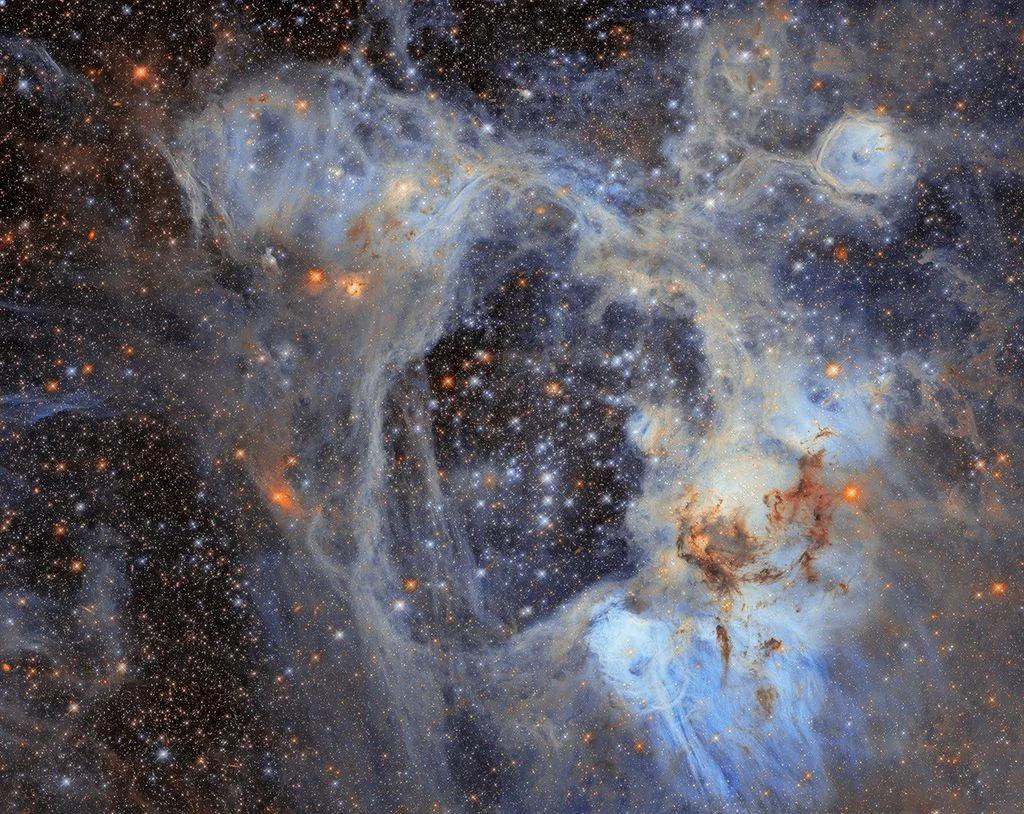
Image Credit: NASA, ESA / Hubble, D. Gouliermis
The image captured by NASA and the European Space Agency shows a large and active nebula called LHA 120-N44 or N44. It is located within the Large Magellanic Cloud, a small galaxy that revolves around our own Milky Way. This small galaxy is situated about 160,000 light years away from the earth. This distance is quite close if we compare it with other intergalactic distances. So Hubble could capture the detail infront of this region of space where the star formation takes place.
N44 is a part of the constellation called Dorado that is mostly visible from the Southern hemisphere. The contrast between two different region makes Hubble Spies Superbubble Scene more beautiful. On one side of the image contains a vast amount of gas, dust, and stars of blue, white, and orange colors. And the middle of the picture has a dark void that is a superbubble found in the center of this nebula region. This superbubble expands about 210 by 140 light-years, where the distance from our sun to Pluto would not reach even a single light-year. So this hollow region inside the nebula is almost impossible to picture using everyday distances.
Why the Superbubble Formed and Why It Is Still a Mystery?

The current theory describes a group of massive, hot stars forming at the center. These stars have powerful stellar winds of charged particles and emitting away from them at very high speed. some of these stars are also blowing up as supernovae, exploding and releasing large amounts of energy into the surrounding area instantly. Some combination of the stellar winds and supernova explosions could be the reason for pushing the gas away and forming the huge void like Hubble Spies Superbubble Scene shows.
As that gas is forced away from the center, it did not simply disappear. It accumulates and condenses into a dense shell at the edge of the void. This shell is where the star formation is happening today. The same process that has created this cavity of emptiness will also give birth to a new generation of stars.
However, even NASA scientists are not completely sure about this theory. The speed of the stellar wind inside the bubble is not fast enough to create a cavity of this size. Also, there is no single supernova remnant at the center to explain the shape and size of the cavity. So, there is still much to be discovered about Hubble Spies Superbubble Scene.
The Science of Star Birth Hidden Inside N44
N44 becomes interesting to scientists not only because of the superbubble, but everything else that happens around it in the gas shell. The data taken by Hubble to survey the nebula, and listed almost a half million (500,000) stars in and around the cluster. Of these, the scientists found almost 30,000 stars that are considered pre-main sequence stars (baby stars). These stars are formed by the collapsing gas clouds, but haven’t yet reached the point in their life cycle where fusion of hydrogen to helium gases has begun in their core.
Discovering many young stars in an area of space is very important to astronomers. It gives them an opportunity to study the entire process from the formation of cold gas into dense gravity wells that cause further stellar evolution. Then the stars begin fusion of lighter elements as the heavy ones are burned. Since the Large Magellanic Cloud has a lower percentage of heavy elements than our own galaxy, the study of star formation can lead to greater understanding on how the stars in the early universe might have formed. This level of detail is the reason why Hubble Spies Superbubble Scene is called one of the observatory’s more scientifically rich images of the year, not just a pretty photo.
A Smaller Bubble Hiding in the Same Image

The main superbubble is not the only interesting feature in the Hubble Spies Superbubble Scene. Near the upper right corner of the frame a smaller structure is present which is called N44F, found by astronomer Karl Henize decades ago in 1950s. Unlike the huge empty space in the middle of the image, N44F was formed by the wind of just one hot massive star, and not a whole star cluster. Earlier close-up shots from Hubble revealed how the radiation and stellar wind from that one star had excavated pillars of dusty gas around itself, forming a miniature version of the same kind of structure found at the center of N44.
By seeing both large, multi-star superbubble and a small, single-star bubble in the same frame is a nice contrast for comparison. It allows researchers to see how the shape and size of the stars affect the scale of the structure they form in the surrounding gas. Anyone looking carefully at the Hubble Spies Superbubble Scene image would notice this smaller bubble, as it almost looks like a preview of the much bigger bubble at the center.
Why This Discovery Matters Beyond a Pretty Picture?
It is easy to gaze at the Hubble Spies Superbubble Scene and impressed by the vibrant colors but the physics behind the scene may have more impact on astrophysics research. By studying superbubbles, scientists are able to investigate how stars contribute to their environment after they died. The material is then recycled back into the ecosystem where it can become part of other planetary systems and help in creating new stars, new planets, and potentially alien life.
The Hubble Spies Superbubble Scene shows why the Hubble Space Telescope is still an important scientific tool even decades after its 1990 launch. While newer telescopes are being built, but they are no match for Hubble’s ability to see the visible part of the spectrum with such precision, especially in crowded star-forming regions like N44. This capability, combined with the longevity of the telescope so photo like the Hubble Spies Superbubble Scene can still be a major headline, even thirty years after its launch.
Conclusion
The Hubble Spies Superbubble Scene reminds us that even well-studied objects in space can still hold surprises. The Hubble Spies Superbubble Scene captures an area in which a huge, 250-light-year-wide cavity sitting inside a glowing nebula and located about 160,000 light-years away from the Earth. The problem is, researchers don’t understand, what process is responsible for creating such an unusual huge void at the center. But the researchers have learnt one thing that the same forces which have carved this space out of their galaxy are also birthing new stars along the cavity’s edges. This makes N44 an especially compelling target for further study. With more information coming each day, the story told by the Hubble Spies Superbubble Scene will only become more interesting as time goes on.